

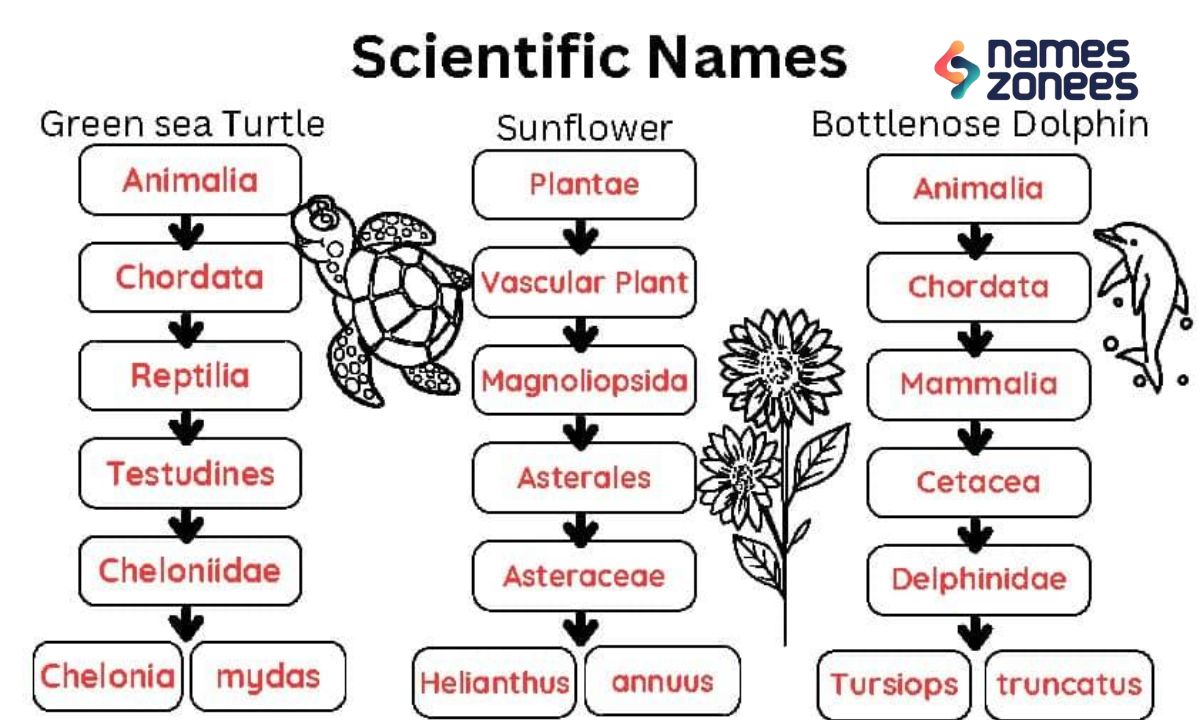
Scientific Names help scientists identify living organisms with precision, even when common names differ between countries or languages. A scientific name usually follows an internationally recognized naming system, making it easier to study animals, plants, fungi, and other forms of life.
Learning Scientific Names also reveals fascinating details about an organism’s history, appearance, habitat, or discoverer. From familiar species to long extinct creatures, these names provide a universal language for biological classification and research.
What Are Scientific Names?
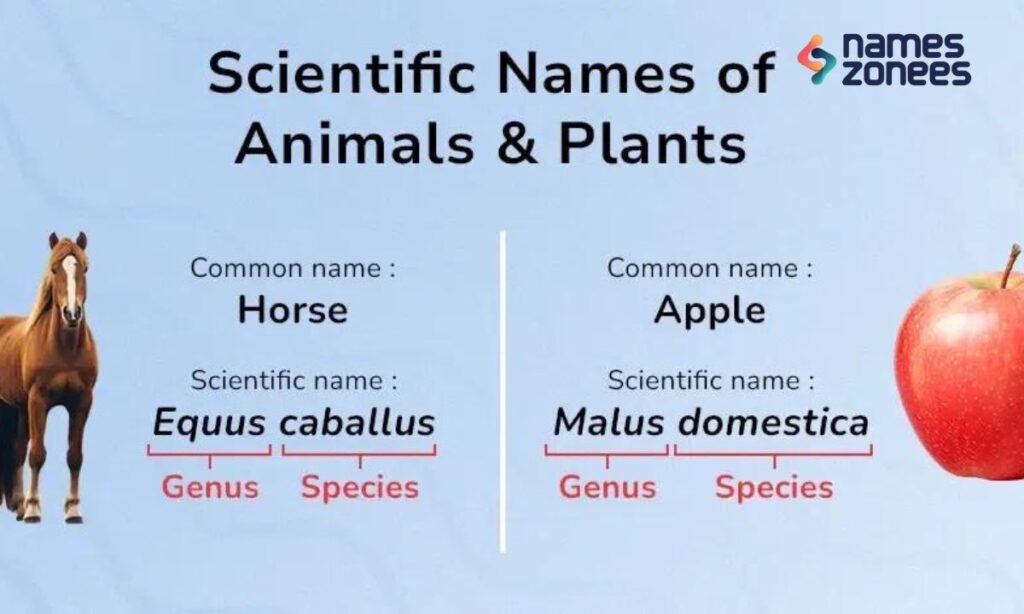
Scientific Names are standardized names assigned to organisms for clear identification.
They usually come from Latin or Latinized Greek words and often describe a useful feature.
The following examples show how scientific names connect species with their formal identity.
| Name | Meaning |
| Homo sapiens | • “Wise” or “knowing human,” referring to modern humans. |
| Canis lupus | • “Dog wolf,” the formal name of the gray wolf. |
| Felis catus | • “Cat,” referring to the domestic cat. |
| Panthera leo | • “Lion panther,” the scientific name of the lion. |
| Elephas maximus | • “Great elephant,” describing the Asian elephant. |
| Equus caballus | • “Horse,” referring to the domestic horse. |
| Bos taurus | • “Cattle” or “bull,” referring to domestic cattle. |
| Ovis aries | • “Sheep” or “ram,” referring to domestic sheep. |
| Capra hircus | • “Goat,” referring to the domestic goat. |
| Sus scrofa | • “Pig” or “swine,” referring to the wild boar species. |
| Gallus gallus | • “Rooster” or “chicken,” referring to the red junglefowl species. |
| Anas platyrhynchos | • “Broad billed,” describing the mallard’s bill. |
| Columba livia | • “Bluish or lead colored dove,” describing the rock pigeon. |
| Corvus corax | • A Latin name associated with the raven and its call. |
| Aquila chrysaetos | • “Golden eagle,” referring to its golden coloration. |
| Strix aluco | • Latin for the tawny owl. |
| Bubo bubo | • A traditional Latinized name associated with the eagle owl. |
| Crocodylus niloticus | • “Crocodile of the Nile,” indicating its geographic association. |
| Testudo graeca | • “Greek tortoise,” referring to its historical geographic designation. |
| Python regius | • “Royal python,” referring to the ball python. |
| Naja naja | • A Latinized form of a traditional cobra name. |
| Chelonia mydas | • “Green tortoise,” referring to the green sea turtle. |
| Delphinus delphis | • A traditional Greek and Latin name for the dolphin. |
| Balaenoptera musculus | • “Muscular whale,” the scientific name of the blue whale. |
| Orcinus orca | • A traditional Latinized name for the orca. |
| Ursus arctos | • “Bear bear,” derived from related Latin and Greek terms. |
| Ailuropoda melanoleuca | • “Black and white cat foot,” describing the giant panda. |
| Gorilla gorilla | • A name derived from an ancient term used for hairy people. |
| Pongo pygmaeus | • “Pygmy orangutan,” based on the species’ traditional name. |
| Macaca mulatta | • A traditional scientific name for the rhesus macaque. |
Binomial Nomenclature Explained
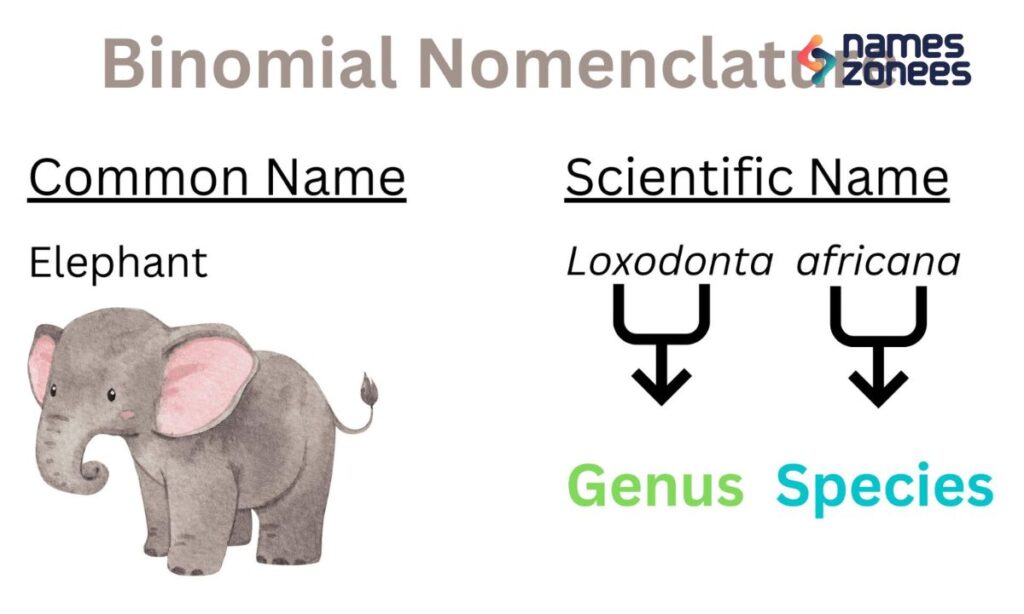
Binomial nomenclature gives each species a two-part scientific name.
The first word identifies the genus, while the second word identifies the species within that genus.
These examples demonstrate how the two-part system creates consistent biological names.
| Name | Meaning |
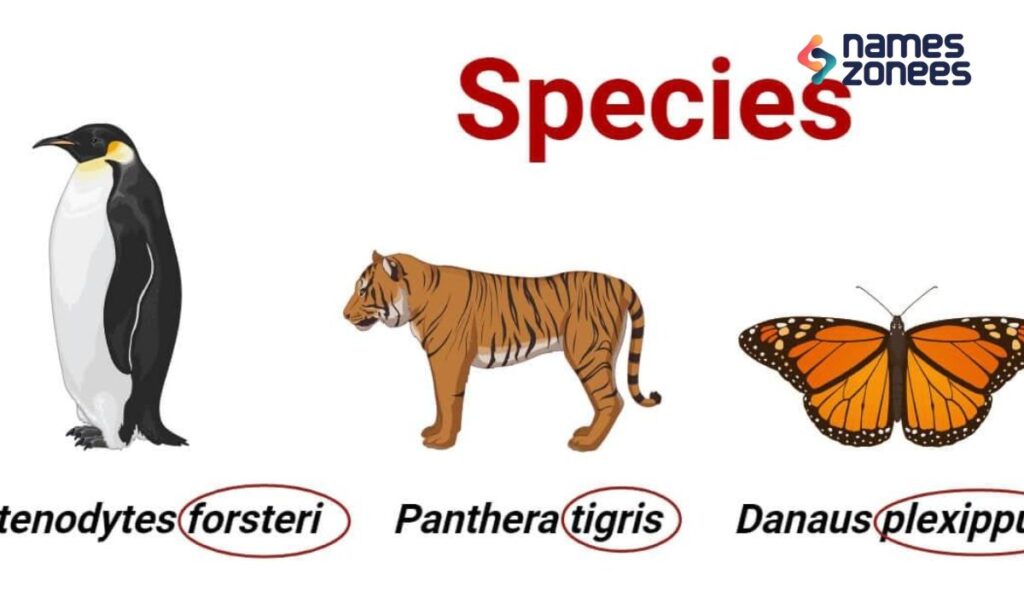
| Panthera tigris | • “Tiger panther,” identifying the tiger within the genus Panthera. |
| Panthera pardus | • “Panther leopard,” referring to the leopard. |
| Panthera onca | • Traditional scientific name of the jaguar. |
| Canis latrans | • “Barking dog,” describing the coyote. |
| Canis aureus | • “Golden dog,” referring to the golden jackal. |
| Vulpes vulpes | • A traditional Latinized name for the red fox. |
| Ursus maritimus | • “Maritime bear,” describing the polar bear’s Arctic association. |
| Mustela erminea | • Traditional name of the stoat or ermine. |
| Lutra lutra | • Traditional Latinized name for the Eurasian otter. |
| Enhydra lutris | • “Sea otter,” referring to its marine lifestyle. |
| Procyon lotor | • “Washer,” referring to the raccoon’s characteristic food handling. |
| Mephitis mephitis | • A name associated with a foul odor, referring to the striped skunk. |
| Sciurus vulgaris | • “Common squirrel,” referring to the red squirrel. |
| Castor canadensis | • “Canadian beaver,” indicating geographic association. |
| Lepus europaeus | • “European hare,” indicating its broad European distribution. |
| Oryctolagus cuniculus | • “Burrowing hare,” describing the European rabbit’s digging behavior. |
| Erinaceus europaeus | • “European hedgehog,” indicating its geographic range. |
| Talpa europaea | • “European mole,” indicating its geographic association. |
| Rattus norvegicus | • “Norwegian rat,” a historical geographic name for the brown rat. |
| Mus musculus | • A Latinized term associated with the small mouse. |
| Pteropus vampyrus | • “Vampire flying creature,” an old descriptive name for a large flying fox. |
| Pipistrellus pipistrellus | • Traditional repeated name for the common pipistrelle bat. |
| Loxodonta africana | • “African slanting toothed animal,” referring to the African savanna elephant. |
| Rhinoceros unicornis | • “One horn,” describing the greater one horned rhinoceros. |
| Hippopotamus amphibius | • “River horse,” reflecting its Greek derived name and semi aquatic life. |
| Giraffa camelopardalis | • A name linking the giraffe with camel and leopard like features. |
| Acinonyx jubatus | • A name associated with the cheetah’s spotted coat and claws. |
| Hyena hyaena | • Traditional repeated name for the striped hyena. |
| Phascolarctos cinereus | • “Ash gray pouch bear,” describing the koala. |
| Vombatus ursinus | • A traditional scientific name for the common wombat. |
Scientific Names of Animals
Animal Scientific Names allow researchers to distinguish closely related species.
They are especially useful when one common name can refer to several different organisms.
This selection covers mammals, birds, reptiles, amphibians, fish, and invertebrates.
| Name | Meaning |
| Ailuropoda melanoleuca | • Black and white cat foot, describing the giant panda. |
| Meles meles | • Traditional Latinized name of the European badger. |
| Taxidea taxus | • Traditional name of the American badger. |
| Marmota marmota | • Traditional repeated name for the Alpine marmot. |
| Myocastor coypus | • Traditional scientific name of the coypu or nutria. |
| Hydrochoerus hydrochaeris | • Traditional scientific name associated with the capybara. |
| Dasyurus maculatus | • “Spotted,” describing the spotted tailed quoll. |
| Phocoena phocoena | • Traditional name for the harbor porpoise. |
| Monodon monoceros | • “One toothed, one horned,” referring to the narwhal. |
| Physeter macrocephalus | • “Big headed,” describing the sperm whale. |
| Megaptera novaeangliae | • “Big winged New Englander,” referring to the humpback whale. |
| Eubalaena glacialis | • “Good or true whale of the ice,” referring to the North Atlantic right whale. |
| Trichechus manatus | • Traditional scientific name of the West Indian manatee. |
| Dugong dugon | • Traditional repeated name for the dugong. |
| Tachyglossus aculeatus | • “Quick tongue, spiny,” describing the short beaked echidna. |
| Ornithorhynchus anatinus | • “Bird snout, duck like,” describing the platypus. |
| Struthio camelus | • “Camel ostrich,” comparing the ostrich’s appearance with a camel. |
| Spheniscus demersus | • “Wedge shaped,” referring to the African penguin’s body form. |
| Aptenodytes forsteri | • “Wingless diver,” referring to the emperor penguin. |
| Falco peregrinus | • “Wanderer,” describing the peregrine falcon’s migratory nature. |
| Pandion haliaetus | • Traditional Greek derived name for the osprey. |
| Psittacus erithacus | • Traditional scientific name for the African gray parrot. |
| Ramphastos toco | • Traditional scientific name for the toco toucan. |
| Ara macao | • Traditional name for the scarlet macaw. |
| Iguana iguana | • Traditional repeated name for the green iguana. |
| Varanus komodoensis | • “Of Komodo,” indicating its geographic origin. |
| Ambystoma mexicanum | • “Mexican,” referring to the axolotl’s geographic association. |
| Rana temporaria | • “Temporary or seasonal,” associated with the common frog. |
| Salamandra salamandra | • Traditional repeated name for the fire salamander. |
| Danio rerio | • Traditional scientific name of the zebrafish. |
Common Animals and Their Scientific Names
Common animal names are convenient in everyday speech, but they can sometimes be ambiguous.
Scientific Names provide a precise reference that researchers can use worldwide.
The table below highlights additional familiar species and the meaning behind their formal names.
| Name | Meaning |
| Pan troglodytes | • “Cave dwelling,” traditionally referring to the common chimpanzee. |
| Pan paniscus | • Traditional scientific name of the bonobo. |
| Pongo abelii | • Scientific name of the Sumatran orangutan, honoring M. Abel. |
| Gorilla beringei | • Scientific name honoring explorer Friedrich Beringe. |
| Papio anubis | • Named after Anubis, the ancient Egyptian deity. |
| Cercopithecus diana | • Named after Diana, the Roman goddess associated with hunting. |
| Lemur catta | • “Cat lemur,” describing the ring tailed lemur. |
| Tarsius tarsier | • Traditional repeated name associated with the tarsier. |
| Daubentonia madagascariensis | • “Of Madagascar,” identifying its geographic origin. |
| Myrmecophaga tridactyla | • “Ant eater with three fingers,” describing the giant anteater. |
| Tamandua tetradactyla | • “Four fingered,” describing the southern tamandua. |
| Bradypus variegatus | • “Varied,” describing the brown throated three toed sloth. |
| Choloepus hoffmanni | • Scientific name honoring naturalist Karl Hoffmann. |
| Dasypus novemcinctus | • “Nine banded,” describing the nine banded armadillo. |
| Myrmecobius fasciatus | • “Ant eating, banded,” describing the numbat. |
| Phascolarctos cinereus | • “Ash gray pouch bear,” describing the koala. |
| Macropus giganteus | • “Giant long foot,” describing the eastern gray kangaroo. |
| Osphranter rufus | • “Red,” referring to the red kangaroo’s coloration. |
| Bettongia penicillata | • “Brush tailed,” describing the woylie’s tail. |
| Perameles nasuta | • “Long nosed,” describing the long nosed bandicoot. |
| Thylacinus cynocephalus | • “Dog headed pouched animal,” describing the thylacine. |
| Sarcophilus harrisii | • “Flesh loving,” referring to the Tasmanian devil’s feeding habits. |
| Dendrolagus lumholtzi | • “Tree hare,” describing a tree kangaroo; named after Lumholtz. |
| Bettongia gaimardi | • Scientific name honoring zoologist Joseph Paul Gaimard. |
| Petaurus breviceps | • “Short headed rope dancer,” describing the sugar glider. |
| Trichosurus vulpecula | • “Fox like hairy tailed animal,” describing the common brushtail possum. |
| Pseudocheirus peregrinus | • “False hand, wandering,” referring to the common ringtail possum. |
| Macropus fuliginosus | • “Sooty or smoky,” describing the western gray kangaroo. |
| Notoryctes typhlops | • “Southern blind digger,” describing the southern marsupial mole. |
| Myrmecobius fasciatus | • “Ant eater with bands,” describing the numbat. |
Scientific Names of Plants
Plant Scientific Names create a universal system for identifying species across regions.
A botanical name can describe color, shape, habitat, origin, or a notable characteristic.
These examples include familiar food crops, trees, flowers, and useful plants.
| Name | Meaning |
| Mangifera indica | • “Indian mango bearing,” referring to the mango tree. |
| Musa acuminata | • “Pointed,” describing the acuminate features of this banana species. |
| Malus domestica | • “Domesticated,” referring to the cultivated apple. |
| Pyrus communis | • “Common pear,” referring to the European pear. |
| Prunus persica | • “Persian,” a historical geographic reference for the peach. |
| Prunus avium | • “Bird cherry,” referring to the sweet cherry. |
| Citrus sinensis | • “Chinese,” a historical geographic reference for the sweet orange. |
| Citrus limon | • “Lemon,” referring to the lemon tree and fruit. |
| Coffea arabica | • “Arabian,” reflecting its historical geographic association. |
| Theobroma cacao | • “Food of the gods,” referring to cacao. |
| Solanum lycopersicum | • Formal botanical name of the tomato. |
| Solanum tuberosum | • “Tuberous,” referring to the potato’s underground tubers. |
| Capsicum annuum | • “Annual,” referring to the species’ historical botanical classification. |
| Zea mays | • Traditional scientific name of maize or corn. |
| Oryza sativa | • “Cultivated,” referring to cultivated rice. |
| Triticum aestivum | • “Summer,” referring to common wheat and its traditional classification. |
| Hordeum vulgare | • “Common,” referring to cultivated barley. |
| Avena sativa | • “Cultivated,” referring to common oat. |
| Glycine max | • Scientific name of soybean. |
| Cicer arietinum | • “Ram like,” describing the chickpea seed shape. |
| Pisum sativum | • “Cultivated,” referring to garden pea. |
| Phaseolus vulgaris | • “Common,” referring to common bean. |
| Allium cepa | • Traditional botanical name of onion. |
| Allium sativum | • “Cultivated,” referring to garlic. |
| Daucus carota | • Traditional botanical name of carrot. |
| Brassica oleracea | • “Vegetable plant,” referring to a major vegetable species. |
| Spinacia oleracea | • “Vegetable,” referring to spinach. |
| Solanum melongena | • Traditional botanical name of eggplant. |
| Cucumis sativus | • “Cultivated,” referring to cucumber. |
| Citrullus lanatus | • “Woolly or hairy,” referring to the watermelon species name. |
Popular Plants and Their Scientific Names
Popular garden and household plants often have many regional common names.
Formal botanical names help gardeners, researchers, and growers identify the exact species.
The following selection focuses on recognizable ornamental and landscape plants.
| Name | Meaning |
| Rosa gallica | • “Gallic or French rose,” referring to its historical geographic association. |
| Rosa canina | • “Dog rose,” referring to the traditional name of the species. |
| Tulipa gesneriana | • Botanical name of a widely cultivated garden tulip, honoring Gesner. |
| Helianthus annuus | • “Sun flower, annual,” describing the sunflower. |
| Lavandula angustifolia | • “Narrow leaved,” describing the lavender’s leaves. |
| Mentha spicata | • “Spiked,” referring to the flowering spikes of spearmint. |
| Ocimum basilicum | • Traditional botanical name of sweet basil. |
| Rosmarinus officinalis | • Historical botanical name associated with rosemary. |
| Salvia officinalis | • “Medicinal or healing,” referring to common sage. |
| Thymus vulgaris | • “Common,” referring to common thyme. |
| Origanum vulgare | • “Common,” referring to oregano. |
| Petroselinum crispum | • “Curly,” describing the leaves of parsley varieties. |
| Foeniculum vulgare | • “Common,” referring to fennel. |
| Zingiber officinale | • Traditional botanical name of cultivated ginger. |
| Curcuma longa | • “Long,” referring to the turmeric plant’s traditional botanical description. |
| Aloe vera | • “True aloe,” reflecting the traditional meaning of vera. |
| Nerium oleander | • Traditional botanical name of oleander. |
| Jasminum officinale | • “Medicinal or useful,” referring to common jasmine. |
| Gardenia jasminoides | • “Jasmine like,” describing the gardenia’s fragrant flowers. |
| Hibiscus rosa-sinensis | • “Rose of China,” a traditional descriptive name. |
| Bougainvillea spectabilis | • “Spectacular,” describing its showy appearance. |
| Plumeria rubra | • “Red,” referring to the species’ reddish coloration. |
| Magnolia grandiflora | • “Large flowered,” describing its large blossoms. |
| Quercus robur | • “Strength,” reflecting the oak’s strong wood. |
| Acer rubrum | • “Red,” describing the red maple. |
| Betula pendula | • “Hanging or pendulous,” describing its drooping branches. |
| Cedrus deodara | • “Wood of the gods,” from Sanskrit derived terminology. |
| Ficus benjamina | • Scientific name of the weeping fig. |
| Dracaena trifasciata | • “Three banded,” describing the leaf markings of the snake plant. |
| Epipremnum aureum | • “Golden,” referring to the golden variegation of golden pothos. |
Scientific Names of Extinct Species
Extinct species also receive formal names under scientific naming conventions.
Their names may preserve information about fossils, locations, anatomy, or historical researchers.
These examples represent famous extinct animals from different geological periods.
| Name | Meaning |
| Tyrannosaurus rex | • “Tyrant lizard king,” describing its perceived dominance and size. |
| Triceratops horridus | • “Three horned face,” with horridus meaning rough or formidable. |
| Velociraptor mongoliensis | • “Swift robber,” referring to its speed and predatory nature. |
| Stegosaurus stenops | • “Roof lizard, narrow faced,” describing its anatomy. |
| Brachiosaurus altithorax | • “Arm lizard, deep chested,” describing its body structure. |
| Diplodocus carnegii | • Named for industrialist Andrew Carnegie; Diplodocus means “double beam.” |
| Apatosaurus ajax | • “Deceptive lizard,” with Ajax honoring the mythological Greek hero. |
| Allosaurus fragilis | • “Different lizard,” with fragilis meaning fragile. |
| Spinosaurus aegyptiacus | • “Egyptian spine lizard,” referring to its long spines and fossil origin. |
| Ankylosaurus magniventris | • “Fused lizard, great belly,” describing its armored body. |
| Parasaurolophus walkeri | • “Near crested lizard,” named with walkeri honoring a person. |
| Iguanodon bernissartensis | • “Iguana tooth,” referring to its tooth shape; named for Bernissart fossils. |
| Pachycephalosaurus wyomingensis | • “Thick headed lizard,” with the species name indicating Wyoming. |
| Compsognathus longipes | • “Elegant jaw, long foot,” describing its anatomy. |
| Archaeopteryx lithographica | • “Ancient wing,” with the species name referring to lithographic fossil discovery. |
| Pteranodon longiceps | • “Wing without teeth, long headed,” describing its anatomy. |
| Mosasaurus hoffmannii | • “Meuse lizard,” named after the Meuse region; hoffmannii honors Hoffmann. |
| Ichthyosaurus communis | • “Fish lizard, common,” describing its fish like body. |
| Plesiosaurus dolichodeirus | • “Near lizard, long necked,” describing its anatomy. |
| Dimetrodon grandis | • “Two measures of teeth, large,” referring to its differentiated teeth. |
| Smilodon fatalis | • “Knife tooth, deadly,” describing its enlarged canine teeth. |
| Mammuthus primigenius | • “First born or original,” referring to the woolly mammoth species. |
| Megatherium americanum | • “Great beast,” referring to the giant ground sloth. |
| Dodo cucullatus | • “Hooded,” referring to the extinct dodo bird. |
| Aepyornis maximus | • “High bird, greatest,” referring to the giant elephant bird. |
| Moa giganteus | • “Giant moa,” referring to its enormous size. |
| Thylacinus cynocephalus | • “Dog headed pouched animal,” describing the thylacine. |
| Diprotodon optatum | • “Two front teeth,” describing its large incisors. |
| Titanoboa cerrejonensis | • “Titan boa,” referring to its enormous size and fossil locality. |
| Coelacanthus granulatus | • “Hollow spine fish, granular,” describing anatomical features. |
Famous Extinct Animals and Their Names
Famous extinct animals often become known through fossils, museums, and scientific discoveries.
Their formal names preserve clues about their anatomy, classification, or discovery history.
The following examples add further extinct organisms without repeating earlier species.
| Name | Meaning |
| Giganotosaurus carolinii | • “Giant southern lizard,” with the species name honoring discoverer Rubén Carolini. |
| Carnotaurus sastrei | • “Meat eating bull,” describing its horns and predatory habits. |
| Deinocheirus mirificus | • “Terrible hand,” with mirificus meaning extraordinary. |
| Therizinosaurus cheloniformis | • “Scythe lizard, turtle formed,” referring to its enormous claws. |
| Oviraptor philoceratops | • “Egg thief, fond of horned faces,” based on its original interpretation. |
| Protoceratops andrewsi | • “First horned face,” with the species name honoring Roy Chapman Andrews. |
| Maiasaura peeblesorum | • “Good mother lizard,” referring to evidence of parental care. |
| Edmontosaurus annectens | • “Edmonton lizard,” with annectens meaning connecting. |
| Parasaurolophus tubicen | • “Near crested lizard, trumpet player,” referring to its hollow crest. |
| Pachyrhinosaurus lakustai | • “Thick nosed lizard,” honoring Walter Lakusta. |
| Albertosaurus sarcophagus | • “Alberta lizard,” with sarcophagus meaning flesh eater. |
| Gorgosaurus libratus | • “Dreadful lizard,” referring to its predatory nature. |
| Troodon formosus | • “Wounding tooth,” with formosus meaning beautifully formed. |
| Ornithomimus velox | • “Bird mimic, swift,” describing its bird like appearance and speed. |
| Deinonychus antirrhopus | • “Terrible claw, counterbalancing,” describing its large sickle claw and anatomy. |
| Microraptor gui | • “Small robber,” referring to its small body and predatory lifestyle. |
| Confuciusornis sanctus | • Named after Confucius; sanctus means sacred. |
| Ichthyornis dispar | • “Fish bird, different,” describing its fish eating bird like form. |
| Hesperornis regalis | • “Western bird, royal,” describing this extinct seabird. |
| Gastornis gigantea | • “Giant Gastornis,” named for Gaston Planté. |
| Argentavis magnificens | • “Magnificent Argentine bird,” describing its size and fossil origin. |
| Phorusrhacos longissimus | • A name associated with a large terror bird; longissimus means longest. |
| Dunkleosteus terrelli | • Named for David Dunkle; osteus means bony. |
| Helicoprion bessonowi | • “Spiral saw,” referring to its unusual spiral tooth whorl. |
| Megalodon megalodon | • “Great tooth,” referring to its enormous fossil teeth. |
| Pliosaurus funkei | • Named in honor of Bjørn and May-Liss Funke. |
| Opabinia regalis | • Named after Opabin Pass; regalis means royal. |
| Hallucigenia sparsa | • “Hallucination,” referring to its strange appearance; sparsa means scattered. |
| Anomalocaris canadensis | • “Unusual shrimp,” with the species name referring to Canada. |
| Marrella splendens | • Named after John Edmunds Marrell; splendens means shining or splendid. |
Read More: https://nameszonees.com/private-story-names/
How Scientific Names Are Written
Scientific Names follow formatting conventions that make them recognizable in academic writing.
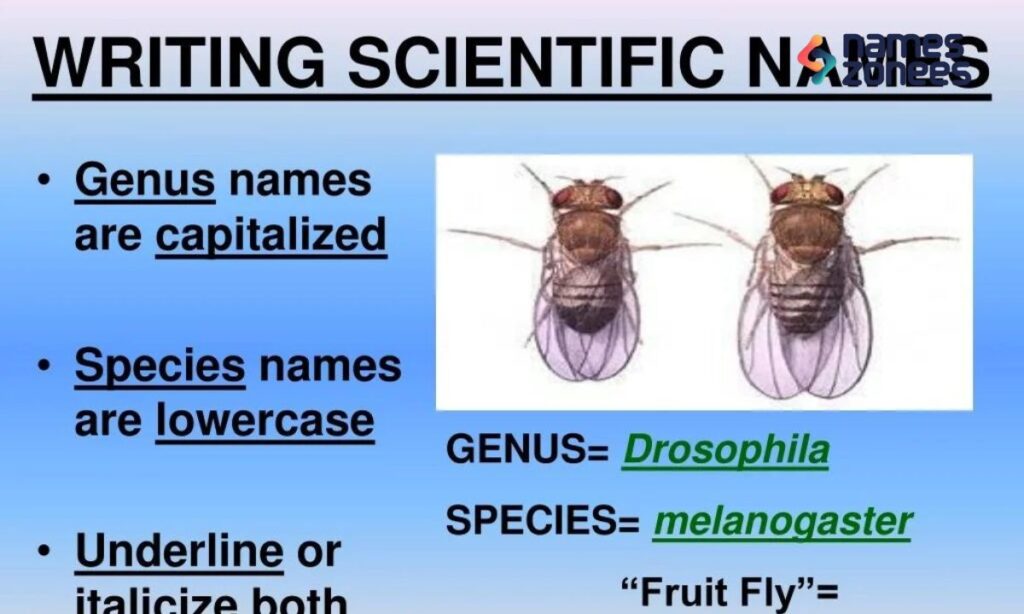
The genus begins with a capital letter, while the specific epithet begins with lowercase letters.
The examples below illustrate additional correctly formatted two word names and their meanings.
| Name | Meaning |
| Acer saccharum | • “Maple sugar,” referring to the sugar maple. |
| Quercus alba | • “White oak,” describing the white oak. |
| Pinus sylvestris | • “Forest pine,” referring to Scots pine. |
| Picea abies | • Traditional scientific name of Norway spruce. |
| Abies alba | • “White fir,” describing the silver fir. |
| Sequoia sempervirens | • “Ever living,” referring to the coast redwood’s evergreen nature. |
| Eucalyptus globulus | • “Little sphere,” referring to the rounded flower bud. |
| Acacia dealbata | • “Whitened,” describing the silvery appearance of silver wattle. |
| Albizia julibrissin | • Scientific name of Persian silk tree. |
| Cocos nucifera | • “Nut bearing,” referring to coconut. |
| Phoenix dactylifera | • “Date bearing,” referring to the date palm. |
| Washingtonia filifera | • “Thread bearing,” describing its leaf fibers. |
| Olea europaea | • “European olive,” indicating its traditional geographic association. |
| Vitis vinifera | • “Vine bearing grapes,” describing the grapevine. |
| Fragaria vesca | • Traditional botanical name of wild strawberry. |
| Rubus idaeus | • Scientific name of raspberry; associated with Mount Ida in the name’s history. |
| Vaccinium corymbosum | • “Corymb bearing,” describing the highbush blueberry’s flower clusters. |
| Coffea canephora | • “Basket bearing,” referring to the robusta coffee species. |
| Camellia sinensis | • “Chinese,” referring to the tea plant’s geographic history. |
| Nicotiana tabacum | • Scientific name of cultivated tobacco. |
| Gossypium hirsutum | • “Hairy,” referring to characteristics of upland cotton. |
| Linum usitatissimum | • “Most useful,” referring to flax’s many traditional uses. |
| Cannabis sativa | • “Cultivated,” referring to cultivated cannabis. |
| Papaver somniferum | • “Sleep bringing,” referring to the opium poppy. |
| Digitalis purpurea | • “Purple,” describing the purple foxglove flowers. |
| Narcissus pseudonarcissus | • “False narcissus,” referring to the daffodil. |
| Crocus sativus | • “Cultivated,” referring to saffron crocus. |
| Vanilla planifolia | • “Flat leaved,” describing the vanilla orchid. |
| Phalaenopsis amabilis | • “Lovely or charming,” describing the moth orchid. |
Why Scientific Names Matter
Scientific Names reduce confusion when common names vary across regions, languages, and cultures.
They also help researchers organize biodiversity and communicate about exact species.
These examples demonstrate the broad range of organisms that formal naming systems can identify.
| Name | Meaning |
| Escherichia coli | • Named after Theodor Escherich; coli means relating to the colon. |
| Saccharomyces cerevisiae | • “Sugar fungus of beer,” referring to baker’s and brewer’s yeast. |
| Penicillium chrysogenum | • “Golden producing,” referring to the mold’s golden colored colonies. |
| Agaricus bisporus | • “Two spored,” describing the common cultivated mushroom. |
| Pleurotus ostreatus | • “Sideways oyster,” referring to the oyster mushroom’s shape. |
| Amanita muscaria | • “Fly,” referring to its historical association with flies. |
| Chlorella vulgaris | • “Common small green one,” describing this green alga. |
| Chlamydomonas reinhardtii | • Scientific name of a widely studied green alga, honoring Alfred Reinhard. |
| Volvox carteri | • Scientific name of a colonial green alga, honoring H. J. Carter. |
| Paramecium caudatum | • “Tailed,” describing the organism’s elongated form. |
| Euglena gracilis | • “Graceful,” describing the slender microorganism. |
| Amoeba proteus | • Named after Proteus, a shape changing figure in Greek mythology. |
| Plasmodium falciparum | • “Sickle shaped,” describing infected red blood cell morphology. |
| Trypanosoma brucei | • “Borer body,” with the species name honoring David Bruce. |
| Giardia duodenalis | • Named after Alfred Giard; duodenalis refers to the duodenum. |
| Taenia solium | • Traditional name of the pork tapeworm; solium has historical Latin interpretations. |
| Ascaris lumbricoides | • “Earthworm like,” describing its worm shaped appearance. |
| Schistosoma mansoni | • “Split body,” with the species name honoring Patrick Manson. |
| Fasciola hepatica | • “Little band, relating to the liver,” describing the liver fluke. |
| Wuchereria bancrofti | • Named after Otto Wucherer and Joseph Bancroft. |
| Apis mellifera | • “Honey bearing,” referring to the honey bee. |
| Bombus terrestris | • “Earthly,” referring to the buff tailed bumblebee. |
| Danaus plexippus | • A traditional Greek derived name used for the monarch butterfly. |
| Papilio machaon | • Named after Machaon, a figure from Greek mythology. |
| Bombyx mori | • “Silkworm of the mulberry,” referring to the domesticated silkworm. |
| Drosophila melanogaster | • “Dark bellied dew lover,” describing the fruit fly. |
| Musca domestica | • “House fly,” referring to its close association with humans. |
| Culex pipiens | • Traditional scientific name of the common house mosquito. |
| Anopheles gambiae | • Scientific name of an important African mosquito species. |
Binomial vs Trinomial Nomenclature
Binomial nomenclature uses two parts, while trinomial nomenclature adds a third name for a subspecies.
The additional term allows taxonomists to distinguish recognized populations within a species.
These examples demonstrate species and subspecies naming patterns without repeating earlier taxa.
| Name | Meaning |
| Canis lupus arctos | • “Arctic wolf,” with arctos referring to the north or Arctic. |
| Canis lupus dingo | • The subspecific name used for the dingo within the wolf species complex. |
| Felis silvestris catus | • “Wild cat, cat,” traditionally used for the domestic cat. |
| Felis silvestris lybica | • “Libyan wild cat,” indicating its historical geographic association. |
| Bison bison bison | • The plains bison subspecies, using the species name as the subspecific epithet. |
| Bison bison athabascae | • “Athabasca,” referring to the wood bison’s geographic association. |
| Lynx rufus rufus | • “Red lynx,” referring to the bobcat and its reddish coloration. |
| Lynx rufus floridanus | • “Floridian,” indicating the Florida bobcat subspecies. |
| Ursus arctos horribilis | • “Bear, bear, frightful,” referring to the grizzly bear. |
| Ursus arctos middendorffi | • Subspecies named in honor of Alexander von Middendorff. |
| Lepus europaeus occidentalis | • “Western European hare,” indicating a geographic population. |
| Lepus timidus hibernicus | • “Irish,” referring to an Irish mountain hare population. |
| Equus asinus somaliensis | • “Somali,” indicating the geographic association of the subspecies. |
| Equus hemionus kulan | • Traditional subspecific name of the kulan or Mongolian wild ass. |
| Equus quagga burchellii | • Subspecies of plains zebra named in honor of William Burchell. |
| Panthera tigris altaica | • “Altaic,” referring to the Siberian tiger’s historical geographic name. |
| Panthera tigris corbetti | • Named in honor of British naturalist Jim Corbett. |
| Panthera leo persica | • “Persian lion,” indicating its historical geographic association. |
| Panthera pardus pardus | • Nominate subspecies of leopard using the species epithet again. |
| Elephas maximus indicus | • “Indian,” referring to the Indian elephant subspecies. |
| Elephas maximus maximus | • Nominate subspecies of the Asian elephant. |
| Gorilla beringei beringei | • Mountain gorilla subspecies; the repeated epithet marks the nominate form. |
| Pan troglodytes schweinfurthii | • Subspecies named in honor of Georg Schweinfurth. |
| Pan troglodytes verus | • “True,” used for the western chimpanzee subspecies. |
| Rangifer tarandus caribou | • The woodland caribou subspecies, using a traditional regional name. |
| Odocoileus virginianus borealis | • “Northern,” describing a northern white tailed deer population. |
| Vulpes vulpes fulva | • “Tawny or reddish yellow,” describing a red fox subspecies. |
| Aquila chrysaetos canadensis | • “Canadian,” indicating a North American golden eagle subspecies. |
| Haliaeetus leucocephalus washingtoniensis | • Subspecific name associated with Washington and the bald eagle. |
| Bubo virginianus virginianus | • Nominate subspecies of the great horned owl, associated with Virginia. |
Frequently Asked Questions
What are Scientific Names used for?
Scientific Names provide a standardized way to identify organisms without relying on regional common names. They are especially valuable in biology, medicine, conservation, agriculture, and education because one accepted name can point researchers toward a specific organism regardless of language or location.
Why do Scientific Names have two words?
Most species are identified through binomial nomenclature, which uses a genus name followed by a specific epithet. The genus is capitalized, while the specific epithet is lowercase. Together, these two terms create a precise species name that can be recognized internationally.
Are Scientific Names always written in Latin?
Scientific Names are generally Latin or Latinized forms, even when their roots come from Greek, indigenous languages, places, or people. Latin was historically useful because it served as an international scholarly language. Modern names continue this tradition while incorporating words from many linguistic sources.
What is the difference between binomial and trinomial naming?
Binomial nomenclature uses two parts to identify a species. Trinomial nomenclature adds a third part when a recognized subspecies is being identified. The additional term provides more detail about a distinct population within a species without creating a completely separate species name.
Why are Scientific Names important for extinct species?
Scientific Names allow paleontologists to identify fossil organisms consistently and distinguish closely related extinct species. They also preserve information about anatomy, location, or discovery history. A formal name makes it easier for researchers worldwide to discuss the same extinct organism accurately.
Conclusion
Scientific Names provide a reliable international language for identifying the enormous diversity of life. They help distinguish species with similar common names while preserving useful information about appearance, geography, classification, and discovery. They are equally valuable for living organisms, plants, microorganisms, and extinct species.
Understanding Scientific Names makes biological information easier to research and compare. Whether studying an animal, identifying a plant, or learning about prehistoric life, knowing how scientific naming works gives readers a clearer view of how scientists organize the natural world.

Jack Smith explores ideas, shares knowledge, and creates content that inspires curiosity and everyday learning.