


Animal group names are special collective nouns used to describe animals when they gather together. From a pride of lions to a murder of crows, these expressions make everyday language more colorful and memorable. Learning Animal Group Names is also a fun way to understand how different species behave socially.
This complete guide brings together Animal Group Names from mammals, birds, reptiles, amphibians, fish, insects, and other invertebrates. Whether you need Animal Group Names for writing, teaching, trivia, schoolwork, or simple curiosity, you will find a wide range of traditional and unusual terms below.
What Are Animal Group Names?
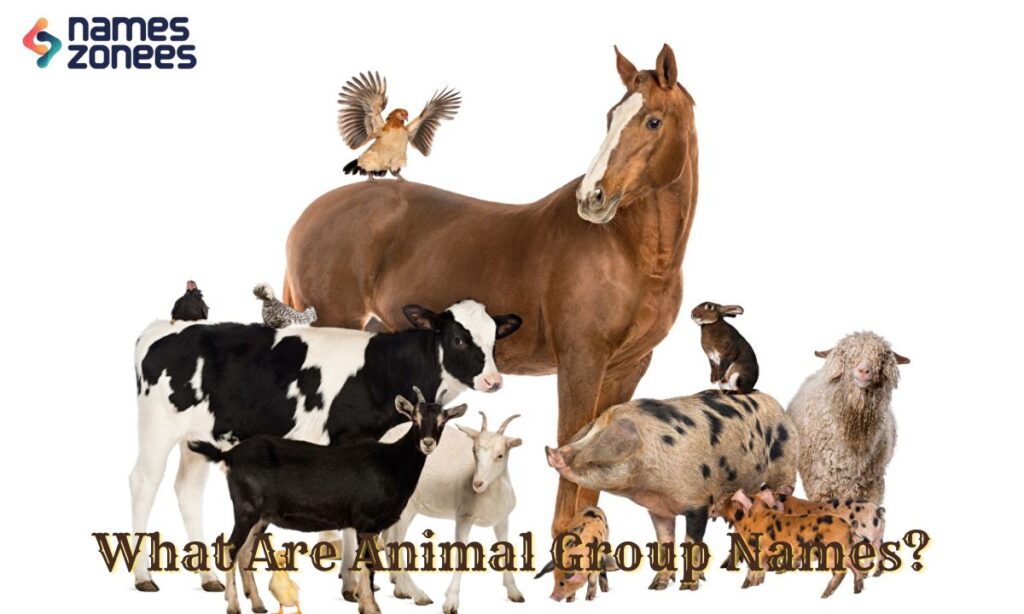
Animal Group Names are collective nouns that describe a number of animals belonging to the same species or category.
Many terms developed from traditional hunting language, folklore, observation, or long-standing English usage.
Some Animal Group Names are widely recognized, while others are rare, regional, or mainly used for literary effect.
| Name | Meaning |
| Herd | • A group of grazing or hoofed animals |
| Pack | • A group of animals, especially canids, that travel or hunt together |
| Pride | • A social group of lions |
| Troop | • A social group commonly used for primates |
| Colony | • A community of animals living together in a shared area |
| Flock | • A group of birds or some grazing animals |
| Swarm | • A large moving group of insects |
| School | • A group of fish moving together |
| Shoal | • A group of fish gathered in the same area |
| Pod | • A social group of marine mammals |
| Brood | • A group of young birds or other animals produced at one time |
| Litter | • A group of young mammals born together |
| Clowder | • A group of cats |
| Drove | • A group of animals being driven or moved together |
| Sounder | • A group of wild pigs or similar swine |
Why Do Animals Live in Groups?
Animals form groups for many practical reasons, including protection, feeding, reproduction, and raising young.
Social living can help individuals detect predators sooner and make finding food or shelter easier.
The Animal Group Names used for these communities often reflect their size, movement, behavior, or social structure.
| Name | Meaning |
| Gaggle | • A group of geese, especially when on land |
| Muster | • A gathering of animals brought together |
| Aggregation | • A collection of animals gathered in one location |
| Assembly | • A group gathered in one place |
| Community | • Animals living and interacting within the same environment |
| Association | • Animals regularly occurring or interacting together |
| Congregation | • A large gathering of animals |
| Gathering | • Animals collected together in one place |
| Cluster | • A closely grouped collection of animals |
| Band | • A social group that travels together |
| Gang | • An informal group of animals moving or living together |
| Party | • A group traveling or foraging together |
| Company | • A group of animals associated together |
| Society | • A structured social community of animals |
| Unit | • A recognizable social group within a species |
Mammal Group Names
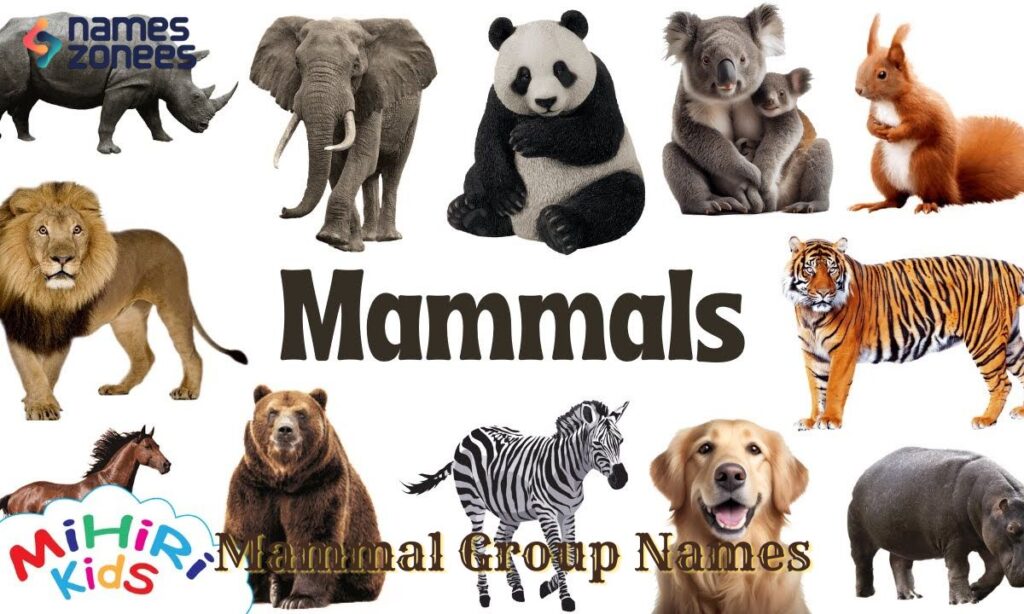
Mammals have some of the most familiar Animal Group Names, including terms associated with lions, elephants, wolves, monkeys, and horses.
Their collective nouns often describe hunting habits, family structures, movement, or traditional human observations.
The following Animal Group Names cover a variety of wild and domestic mammals.
| Name | Meaning |
| Crash | • A group of rhinoceroses |
| Bloat | • A group of hippopotamuses |
| Tower | • A group of giraffes |
| Congress | • A group of baboons |
| Barrel | • A group of monkeys |
| Cartload | • A group of monkeys |
| Shrewdness | • A group of apes |
| Business | • A group of ferrets |
| Skulk | • A group of foxes |
| Leash | • A group of greyhounds |
| Cete | • A group of badgers |
| Sleuth | • A group of bears |
| Moke | • A group of donkeys |
| Team | • A group of horses working together |
| Mob | • A group of kangaroos |
Bird Group Names
Birds are famous for colorful collective nouns, and many of these Animal Group Names have been used for centuries.
Some terms describe birds in flight, while others refer to gatherings on the ground, in trees, or around water.
These Animal Group Names include familiar expressions as well as memorable traditional terms.
| Name | Meaning |
| Murder | • A traditional collective noun for crows |
| Parliament | • A traditional collective noun for owls |
| Exaltation | • A traditional collective noun for larks |
| Charm | • A traditional collective noun for finches |
| Host | • A traditional collective noun for sparrows |
| Convocation | • A traditional collective noun for eagles |
| Kettle | • A group of hawks circling together |
| Committee | • A traditional collective noun for vultures |
| Wake | • A traditional collective noun for vultures |
| Paddling | • A group of ducks on water |
| Raft | • A group of ducks or other waterfowl on water |
| Wedge | • A group of geese flying in formation |
| Siege | • A traditional collective noun for herons |
| Bouquet | • A traditional collective noun for pheasants |
| Pandemonium | • A traditional collective noun for parrots |
Reptile & Amphibian Group Names
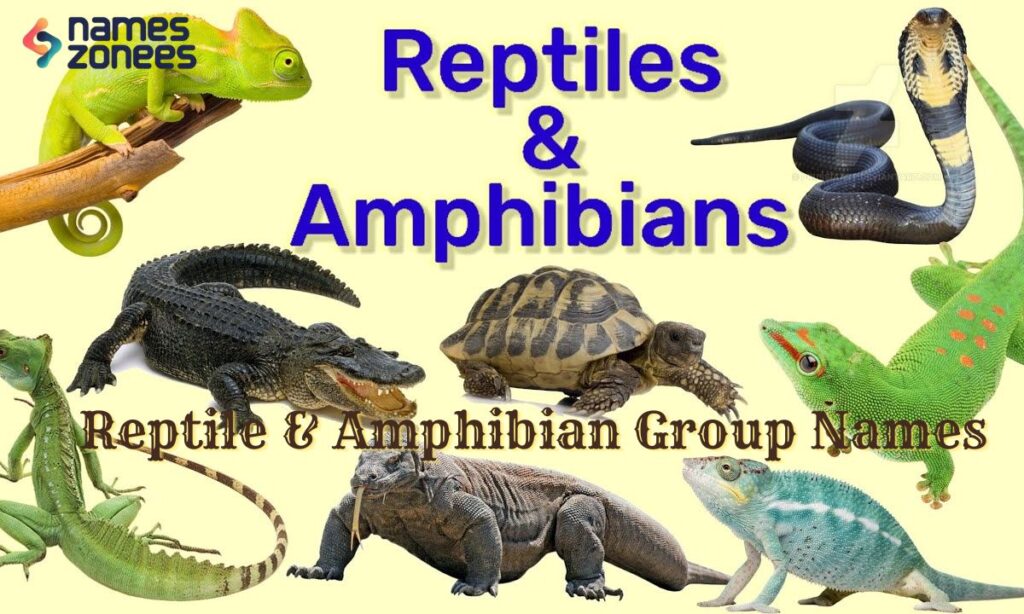
Reptiles and amphibians have fewer widely known collective nouns than mammals and birds.
Some terms are traditional, while others describe gatherings based on habitat or behavior.
These Animal Group Names provide useful examples for snakes, turtles, crocodilians, and amphibians.
| Name | Meaning |
| Knot | • A group of toads |
| Nest | • A group of snakes, especially when gathered together |
| Den | • A group of snakes sharing a shelter |
| Pit | • A group of snakes associated with a shared resting place |
| Bed | • A group of snakes lying together |
| Bask | • A group of reptiles gathered to warm themselves |
| Legion | • A large group of ants or other animals; sometimes applied broadly |
| Bale | • A group of turtles |
| Turn | • A group of turtles |
| Baskery | • A gathering of reptiles while basking |
| Army | • A large organized mass, sometimes used descriptively for crocodilians |
| Nesting | • A gathering of reptiles around nesting activity |
| Rafting | • A gathering of young crocodilians or other reptiles on water |
| Congregation | • A group of amphibians gathered in one area |
| Chorus | • A group of frogs calling together |
Fish Group Names
Fish often move in coordinated groups that can provide protection and improve feeding efficiency.
The words school and shoal are especially common, although several other terms are used for particular fish.
These Animal Group Names help describe both ordinary gatherings and species-specific groups.
| Name | Meaning |
| Gam | • A group of whales or other marine animals, traditionally also used in nautical language |
| Run | • A large movement of fish, especially migrating fish |
| Draft | • A group or movement of fish |
| Catch | • A group of fish caught together |
| Haul | • Fish taken together during fishing |
| Fry | • Young fish considered collectively |
| Fingerling | • Young fish at an early developmental stage |
| Schooling | • Fish moving together in coordinated formation |
| Shoaling | • Fish gathering together without necessarily moving in tight formation |
| Aggregation | • Fish gathered densely in one location |
| Spawning Group | • Fish gathered for reproduction |
| Feeding Group | • Fish gathered where food is abundant |
| Migration | • Fish moving collectively between habitats |
| Swarm | • A large, dense moving group, sometimes descriptively applied to fish |
| Shoalwater | • A gathering associated with shallow-water fish habitat |
Insect & Invertebrate Group Names
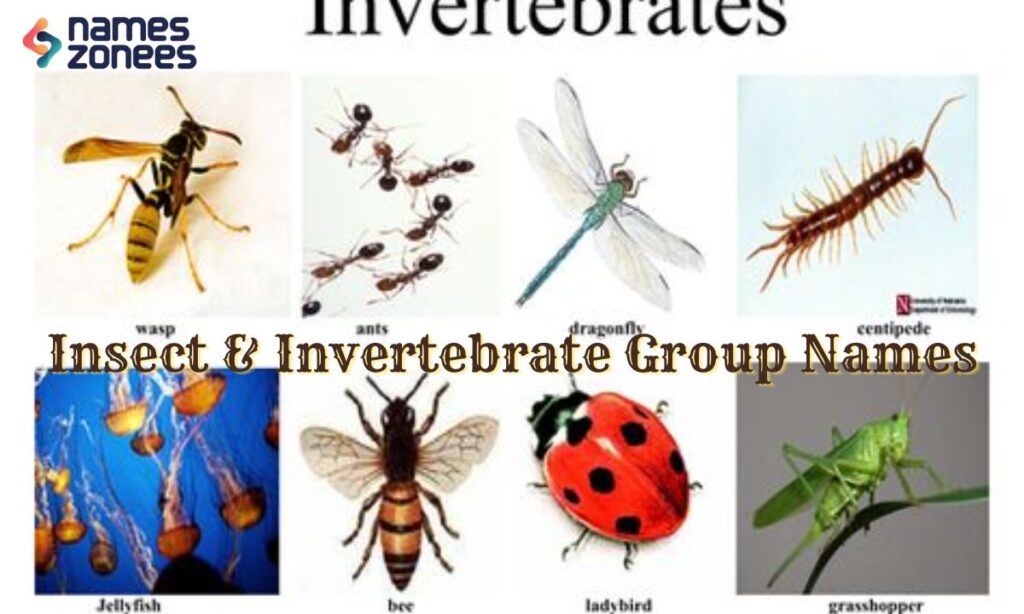
Insects and other invertebrates have some of the most distinctive collective terms in English.
Their Animal Group Names often reflect their enormous numbers, coordinated movement, or colony-based lifestyles.
From bees and ants to spiders and snails, these terms show how varied invertebrate societies can be.
| Name | Meaning |
| Colony | • A social community of ants, bees, termites, or similar insects |
| Hive | • A community of honeybees living together |
| Nest | • A group of social insects living in a nest |
| Army | • A large organized group, especially army ants |
| Business | • A traditional collective noun for flies |
| Kaleidoscope | • A colorful group of butterflies |
| Rabble | • A traditional collective noun for butterflies |
| Flutter | • A group of butterflies moving together |
| Plague | • An enormous destructive concentration of insects |
| Cloud | • A large mass of insects flying together |
| Horde | • A large moving mass of insects |
| Bed | • A group of oysters |
| Cast | • A group of hawks or falcons; also used in broader collective contexts |
| Nestle | • A closely gathered group of small invertebrates |
| Bale | • A traditional collective term used for turtles and occasionally broader animal groupings |
Unique & Funny Animal Group Names
Some Animal Group Names sound amusing because they use unexpected words for ordinary animal gatherings.
These expressions are especially popular in quizzes, trivia games, classroom activities, and creative writing.
The following Animal Group Names stand out because their wording is unusual, vivid, or memorable.
| Name | Meaning |
| Cackle | • A group of hyenas |
| Kaleidoscope | • A group of butterflies |
| Flamboyance | • A group of flamingos |
| Crash | • A group of rhinoceroses |
| Tower | • A group of giraffes |
| Business | • A group of ferrets |
| Shrewdness | • A group of apes |
| Parliament | • A group of owls |
| Exaltation | • A group of larks |
| Charm | • A group of finches |
| Murder | • A group of crows |
| Pandemonium | • A group of parrots |
| Coalition | • A group of cheetahs |
| Prickle | • A group of porcupines |
| Romp | • A group of otters |
Animal Group Names A–Z
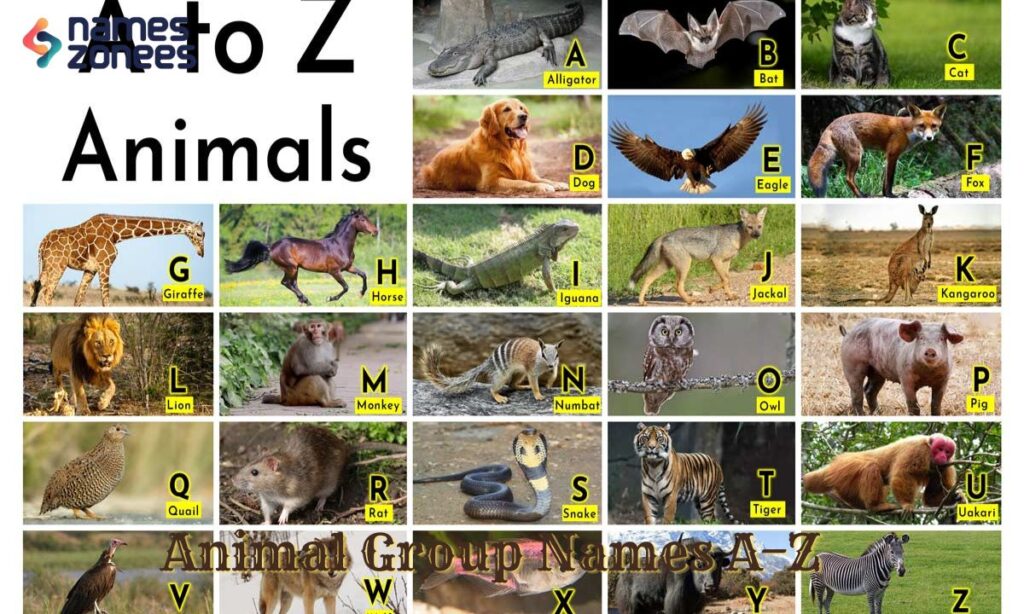
An A–Z collection makes Animal Group Names easier to browse when you need a particular term quickly.
The alphabet includes common collective nouns alongside traditional expressions associated with specific animals.
This selection of Animal Group Names is useful for reference, vocabulary building, trivia, and educational projects.
| Name | Meaning |
| Ambush | • A group of tigers |
| Bale | • A group of turtles |
| Caravan | • A group of camels |
| Dazzle | • A group of zebras |
| Exaltation | • A group of larks |
| Flamboyance | • A group of flamingos |
| Gaggle | • A group of geese |
| Host | • A group of sparrows |
| Intrusion | • A group of cockroaches |
| Kettle | • A group of hawks circling |
| Litter | • A group of young mammals born together |
| Murder | • A group of crows |
| Parliament | • A group of owls |
| Quiver | • A group of cobras |
| Rhumba | • A group of rattlesnakes |
Read More: https://nameszonees.com/baby-girl-names-that-start-with-m/
Most Popular Animal Collective Nouns
Popular Animal Group Names are usually the terms people recognize immediately, such as herd, flock, pack, pride, and school.
They appear frequently in books, educational resources, documentaries, quizzes, and everyday descriptions of wildlife.
These Animal Group Names are excellent starting points for anyone learning collective nouns.
| Name | Meaning |
| Herd | • A group of cattle, deer, elephants, or other hoofed animals |
| Flock | • A group of birds or sheep |
| Pack | • A group of wolves, dogs, or similar animals |
| Pride | • A group of lions |
| School | • A group of fish swimming together |
| Shoal | • A group of fish gathered together |
| Pod | • A group of whales, dolphins, or other marine mammals |
| Swarm | • A large group of bees or flying insects |
| Colony | • A community of social animals living together |
| Troop | • A group of monkeys or other primates |
| Gaggle | • A group of geese on land |
| Brood | • A group of young birds produced by one parent or pair |
| Litter | • A group of young mammals born together |
| Drove | • A group of pigs or other animals being moved together |
| Sounder | • A group of wild pigs |
Rare Animal Group Names
Rare Animal Group Names are especially interesting because many people encounter them only in literature, historical references, or specialized wildlife resources.
Some originated from medieval hunting terminology and have remained in dictionaries despite limited modern use.
Learning unusual Animal Group Names can expand vocabulary while revealing fascinating connections between language and animal behavior.
| Name | Meaning |
| Business | • A traditional group name for ferrets |
| Cete | • A traditional group name for badgers |
| Charm | • A traditional group name for finches |
| Convocation | • A traditional group name for eagles |
| Exaltation | • A traditional group name for larks |
| Murder | • A traditional group name for crows |
| Pandemonium | • A traditional group name for parrots |
| Parliament | • A traditional group name for owls |
| Prickle | • A group of porcupines |
| Rhumba | • A traditional collective noun for rattlesnakes |
| Shrewdness | • A traditional group name for apes |
| Siege | • A traditional group name for herons |
| Unkindness | • A traditional group name for ravens |
| Wake | • A traditional group name for vultures |
| Zeal | • A traditional collective noun associated with zebras |
Frequently Asked Questions
What are Animal Group Names?
Animal Group Names are collective nouns that identify groups of animals, such as a pride of lions, flock of birds, or school of fish.
Why are some Animal Group Names unusual?
Many unusual Animal Group Names developed from historical hunting language, folklore, descriptive traditions, and observations of animal behavior.
What is the most common Animal Group Name?
“Herd” is one of the most familiar Animal Group Names, commonly describing groups of cattle, deer, elephants, and other hoofed animals.
Are Animal Group Names scientifically official?
Not always. Many Animal Group Names are traditional English expressions rather than formal scientific classifications used by zoologists.
Can one animal have more than one group name?
Yes. Some animals have several traditional collective nouns, and usage can vary according to context, location, species, or whether animals are moving together.
Conclusion
Learning Animal Group Names is a simple way to make animal vocabulary more interesting and precise. From familiar terms such as herd and flock to unusual expressions such as parliament and shrewdness, collective nouns reveal how language captures animal behavior and social life.
Whether you are preparing a classroom lesson, creating a quiz, writing creatively, or exploring wildlife vocabulary, this collection provides a useful reference. The variety of Animal Group Names also shows how closely language, culture, observation, and the natural world have been connected for generations.

Jack Smith explores ideas, shares knowledge, and creates content that inspires curiosity and everyday learning.