

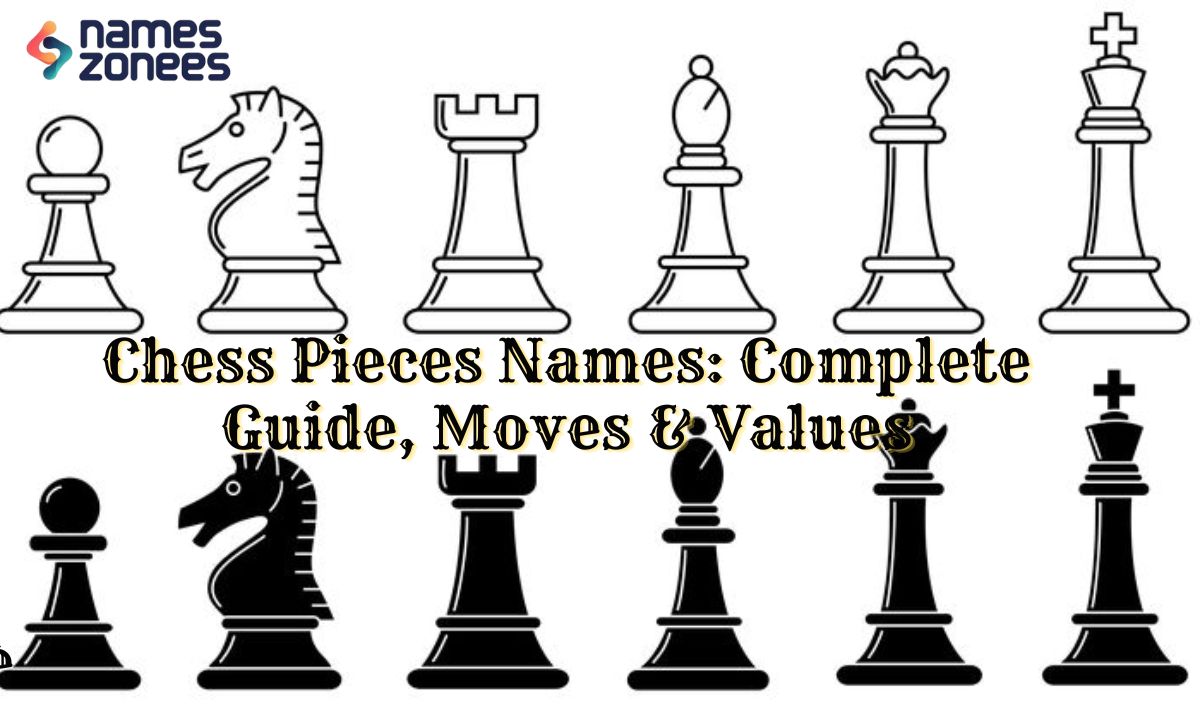
Every game of chess begins the same way: sixteen pieces on each side, sitting in perfect formation, waiting for the first move. But before you can plan an opening or plot a checkmate, it helps to understand chess Pieces Names, what each piece represents, and how it behaves on the board. Whether you’re a complete beginner or brushing up on the fundamentals, knowing chess Pieces Names inside and out is the foundation of every strong player’s game.
This guide walks through all six chess Pieces Names, their point values, their movement patterns, and the special rules that make chess such a rich and strategic game. You’ll also find how chess Pieces Names differ across cultures and languages, the historical origins of these names, and why the Staunton design became the standard chess set used worldwide today. By the end, you’ll have a complete reference for chess Pieces Names and everything that makes them work together on the 64 squares of the board.
Chess Pieces Names and Their Roles
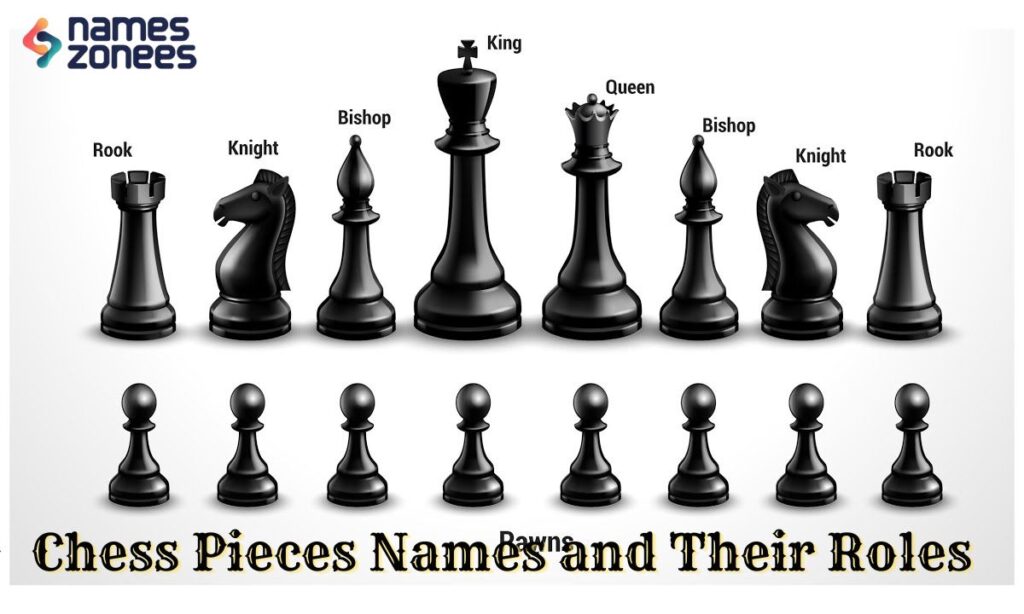
There are six unique chess Pieces Names, and each one plays a distinct role in how a game unfolds. Understanding these roles early makes it much easier to plan attacks, defend your king, and read your opponent’s strategy.
| Piece | Starting Count | Role |
| King | • 1 per side | |
| Queen | • 1 per side | |
| Rook | • 2 per side | |
| Bishop | • 2 per side | |
| Knight | • 2 per side | |
| Pawn | • 8 per side |
The King
The king is the most important of all chess Pieces Names, even though it isn’t the most powerful. The entire game revolves around protecting your king — if it’s checkmated, the game ends immediately, regardless of how many other pieces remain on the board. The king moves only one square in any direction: horizontally, vertically, or diagonally.
Because the king is so vulnerable, players typically move it to safety early in the game through a special move called castling, covered later in this guide. Losing track of your king’s safety is one of the fastest ways to lose a match, no matter how strong your other pieces are.
The Queen
Among all chess Pieces Names, the queen is widely regarded as the most powerful piece on the board. She combines the movement of a rook and a bishop, allowing her to travel any number of squares horizontally, vertically, or diagonally. This flexibility makes the queen a devastating attacking piece capable of controlling large portions of the board at once.
Because of her value, players are usually cautious about exposing the queen too early. Losing her often means losing the game, so most opening strategies focus on developing other pieces first before bringing the queen into active play.
The Rook
The rook, often visually represented as a castle tower, moves in straight lines — horizontally or vertically — across any number of open squares. Rooks are especially powerful in the endgame, when the board opens up and they can control entire files and ranks.
Rooks also play a key role in castling, the only move in chess where two pieces move simultaneously. Coordinating your rooks effectively, especially by connecting them on an open file, is a classic and highly effective mid-to-late-game strategy.
The Bishop
Each side has two bishops, and each one is restricted to diagonal movement for the entire game — one bishop stays on light squares, the other on dark squares. Because of this, bishops work best as a pair, covering squares that the other simply cannot reach.
Bishops are considered slightly more valuable in open positions where diagonals stretch freely across the board, while they can be less effective in cramped, pawn-heavy positions where their movement gets blocked.
The Knight
The knight is the only piece among all chess Pieces Names that can jump over other pieces, making its distinctive L-shaped move (two squares in one direction, then one square perpendicular). This unusual movement makes knights unpredictable and especially dangerous in closed, crowded positions.
Knights are most effective when placed in central squares, where their reach extends across the maximum number of possible landing points. A well-placed knight in the center of the board is often described as a “strong outpost.”
The Pawn
Pawns are the smallest and most numerous of all chess Pieces Names, with eight starting on each side. Despite their low individual value, pawns form the structural backbone of a chess position and heavily influence strategy from the very first move.
Pawns move forward one square at a time (two squares on their first move) but capture diagonally. If a pawn reaches the opposite end of the board, it can be promoted to any other piece — usually a queen — making the humble pawn a piece with surprising long-term potential.
Chess Piece Values
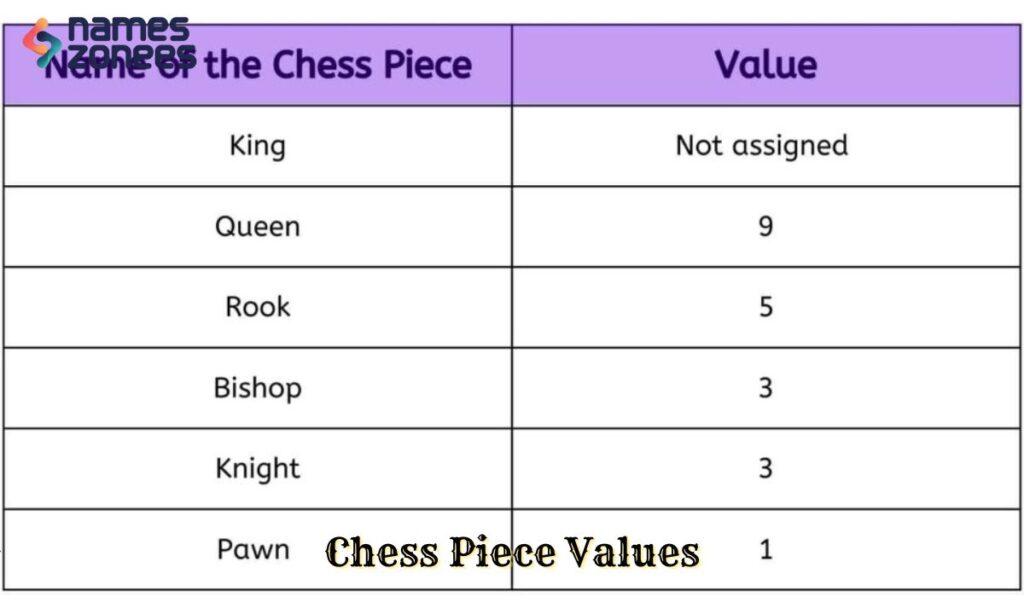
Every experienced player learns the standard point values assigned to chess Pieces Names, since these values help guide decisions during trades and tactical exchanges. The king has no numerical value because it can never be captured or traded.
| Piece | Point Value |
| Pawn | • 1 point |
| Knight | • 3 points |
| Bishop | • 3 points |
| Rook | • 5 points |
| Queen | • 9 points |
| King | • Invaluable (cannot be captured) |
These values are a helpful guideline rather than an absolute rule. Position, activity, and coordination between pieces often matter more than raw point totals, which is why a well-placed knight can sometimes outperform a poorly placed rook.
Which Chess Piece Is Most Powerful?
Based purely on point value and mobility, the queen is the most powerful piece among all chess Pieces Names. Her ability to move like both a rook and a bishop gives her unmatched range and flexibility across the board.
That said, “powerful” depends heavily on context. In the endgame, rooks and pawns often decide the outcome, while knights can dominate closed positions where the queen’s long-range movement is less useful. Strong players learn to evaluate each piece’s power based on the position in front of them, not just its assigned value.
How Chess Pieces Move
Each of the chess Pieces Names has its own unique movement pattern, and mastering these patterns is essential before learning any real strategy.
| Piece | Movement Pattern |
| King | • One square in any direction |
| Queen | • Any number of squares horizontally, vertically, or diagonally |
| Rook | • Any number of squares horizontally or vertically |
| Bishop | • Any number of squares diagonally, staying on one color |
| Knight | • L-shaped move: two squares one way, one square perpendicular; can jump over pieces |
| Pawn | • One square forward (two on first move); captures diagonally one square |
Every piece except the knight is blocked by other pieces in its path, meaning it cannot move through or past another piece to reach its destination.
Special Chess Moves
Beyond standard movement, a few special rules add extra depth and strategy to the game.
Castling allows the king and a rook to move simultaneously, provided neither has moved yet and no pieces sit between them. The king moves two squares toward the rook, and the rook jumps to the square beside the king — a move that improves king safety and activates the rook at the same time.
En passant is a special pawn capture that can occur when an opponent’s pawn moves two squares forward from its starting position, landing beside your own pawn. Your pawn may capture it as though it had only moved one square, but only immediately on the very next move.
Pawn promotion happens when a pawn reaches the final rank on the opposite side of the board. It must be promoted to a queen, rook, bishop, or knight — most players choose a queen, since it’s the most powerful piece, though underpromotion is occasionally used for tactical reasons.
How to Set Up Chess Pieces
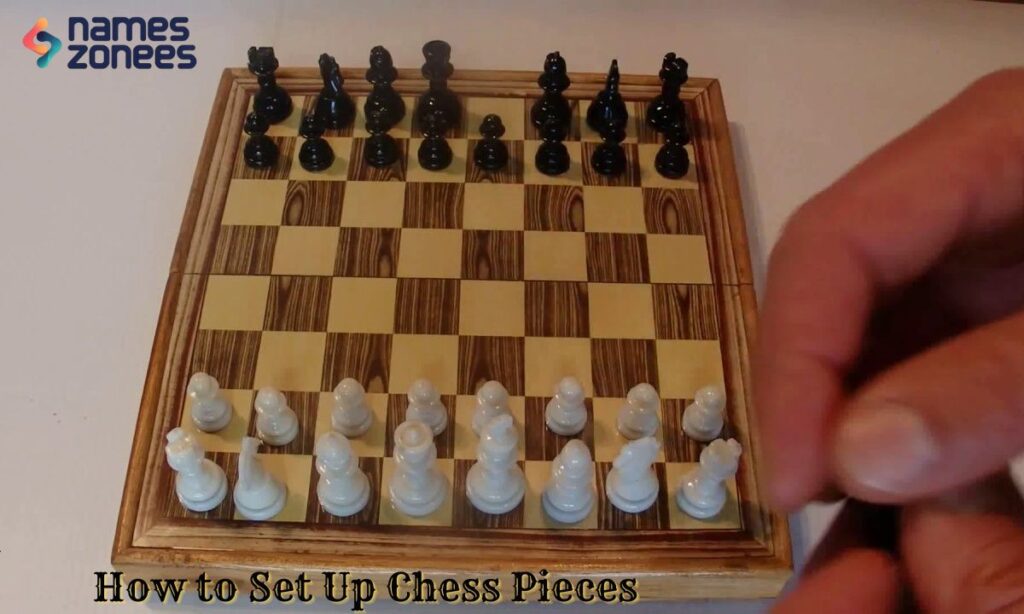
Setting up all the chess Pieces Names correctly is the first step before any game begins. Each side sets up identically, mirrored across the board.
- Place the rooks on the two corner squares of your back row.
- Place the knights next to the rooks.
- Place the bishops next to the knights.
- Place the queen on the remaining square that matches her color (white queen on a light square, black queen on a dark square).
- Place the king on the last remaining square, next to the queen.
- Fill the entire second row with your eight pawns.
A helpful memory trick: “queen goes on her own color” ensures the king and queen are never accidentally swapped.
Chess Pieces Names in Different Countries
Chess Pieces Names change across languages and cultures, though most trace back to shared historical roots. Understanding these regional differences highlights just how globally beloved this game has always been.
| Language/Country | King | Queen | Rook | Bishop | Knight | Pawn |
| English | • King | • Queen | • Rook | • Bishop | • Knight | • Pawn |
| Spanish | • Rey | • Dama/Reina | • Torre | • Alfil | • Caballo | • Peón |
| French | • Roi | • Dame | • Tour | • Fou | • Cavalier | • Pion |
| German | • König | • Dame | • Turm | • Läufer | • Springer | • Bauer |
| Italian | • Re | • Regina | • Torre | • Alfiere | • Cavallo | • Pedone |
| Russian | • Korol | • Ferz | • Ladya | • Slon | • Kon | • Peshka |
| Arabic | • Malik | • Wazir | • Rukh | • Fil | • Faras | • Baidaq |
| Hindi | • Raja | • Wazir/Rani | • Rukh | • Usth/Haathi | • Ghoda | • Pyada |
These variations show how chess Pieces Names evolved differently as the game traveled from its origins in India through Persia, the Arab world, and eventually into Europe.
Read More About This: https://nameszonees.com/name-tracing-practice/
Old Names of Chess Pieces
Modern chess Pieces Names have deep historical roots, tracing back to the ancient Indian game of Chaturanga and its Persian successor, Shatranj. Comparing these old names to their modern equivalents shows how much the game — and its pieces — have evolved over more than a thousand years.
| Modern Piece | Old Persian (Shatranj) Name | Original Meaning |
| King | • Shah | • Ruler or king |
| Queen | • Farzin (Vizier) | • Royal advisor or counselor, not originally a queen |
| Rook | • Rukh | • Chariot |
| Bishop | • Fil | • Elephant |
| Knight | • Asp/Faras | • Horse |
| Pawn | • Piyada | • Foot soldier |
Notably, the queen wasn’t originally the powerful piece we know today — the Farzin, or vizier, could only move one square diagonally. It wasn’t until chess spread through medieval Europe that the piece was reimagined as a queen and given her modern sweeping powers, becoming one of the most significant transformations in chess Pieces Names history.
Staunton Chess Pieces
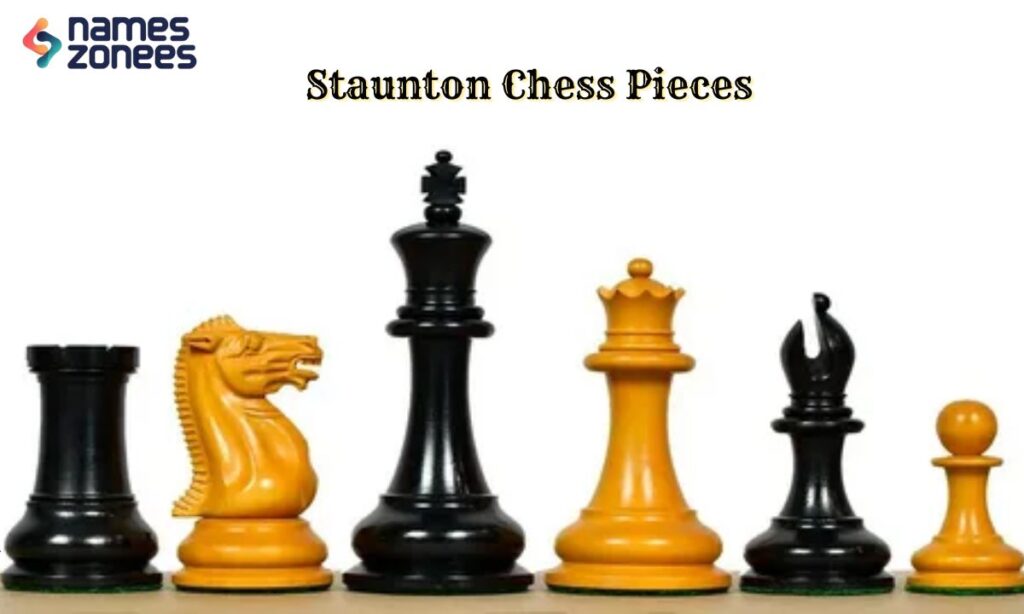
The Staunton chess set, introduced in 1849 and named after English chess champion Howard Staunton, remains the internationally recognized standard for tournament and competitive play. Before Staunton, chess Pieces Names existed, but their physical designs varied wildly by region, making pieces confusing to identify across different sets.
The Staunton design gave each piece a clear, distinctive shape: the king topped with a cross, the queen with a coronet, the bishop with a mitre-shaped top and a notch, the knight carved as a horse’s head, the rook shaped like a castle turret, and the pawn as a simple rounded ball on a small stem. This standardization made it possible for players anywhere in the world to recognize chess pieces’ names visually, regardless of language, which is why the Staunton pattern is still required in official FIDE-sanctioned tournaments today.
Frequently Asked Questions
What are the 6 chess Pieces Names?
The six chess pieces’ names are king, queen, rook, bishop, knight, and pawn. Each side of the board has one king, one queen, two rooks, two bishops, two knights, and eight pawns.
Which chess piece is the most valuable?
The queen is generally considered the most valuable piece at 9 points, thanks to her ability to move in every direction across the board. However, the king holds unmatched strategic importance since losing it ends the game.
Why is the queen more powerful than the king in chess?
The king’s role is purely strategic and defensive, moving only one square at a time to stay safe. The queen, by contrast, combines rook and bishop movement, giving her far greater range and attacking power.
What was the old name for the chess queen?
In the original Persian game of Shatranj, the piece we now call the queen was known as the Farzin, or vizier, and moved only one square diagonally. Her modern powers developed later as chess spread through medieval Europe.
Why is the Staunton design used in official chess tournaments?
The Staunton set standardized how each of the chess Pieces Names looks, making pieces instantly recognizable regardless of a player’s language or region. This consistency is why FIDE requires Staunton-pattern sets for official competitive play.
Conclusion
Learning chess Pieces Names is more than just memorizing labels — it’s about understanding how each piece contributes to the strategy, structure, and story of the game. From the humble pawn’s quiet potential to the queen’s commanding range across the board, every piece plays a role shaped by centuries of history, regional tradition, and evolving rules. Knowing how each piece moves, what it’s worth, and where it came from gives every player, beginner or advanced, a stronger foundation for reading the board.
Chess has traveled across continents and centuries, and its pieces have traveled with it, picking up new names, new shapes, and new meanings along the way. Whether you’re setting up your first board or studying the deeper strategy behind piece coordination, a solid grasp of chess Pieces Names, their values, and their movement patterns will serve you well at every stage of your chess journey.

Jack Smith explores ideas, shares knowledge, and creates content that inspires curiosity and everyday learning.