

Filipino last names reflect centuries of cultural exchange, migration, religion, language, and colonial administration. Today, Filipino Last Names may look Spanish, indigenous, Chinese, or influenced by other traditions, yet a surname alone does not necessarily reveal a person’s ancestry. Names such as Garcia, Reyes, Santos, and dela Cruz became widespread for historical reasons connected to the Spanish colonial naming system.
Understanding Filipino Last Names becomes especially interesting when you explore their meanings and historical roots. Some families preserve surnames from local Philippine languages, while others carry names that entered the country through Spanish administration, Chinese migration, religious traditions, or geographic naming practices. The lists below separate these traditions while noting where a precise etymology is uncertain.
Most Common Filipino Last Names
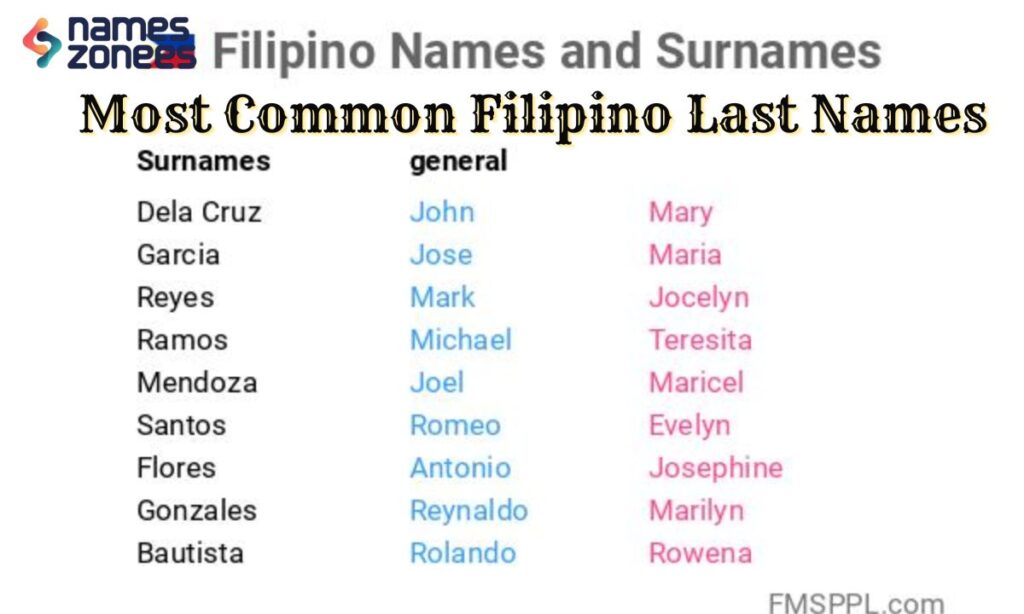
These surnames are among the most frequently encountered family names in the Philippines today.
Many have Spanish or Hispanic forms because of nineteenth-century naming practices.
Their popularity does not automatically indicate Spanish ancestry or descent.
| Name | Meaning |
| dela Cruz | • “Of the Cross,” referring to the Christian cross |
| Garcia | • A Spanish surname of medieval Iberian origin; exact original meaning is uncertain |
| Reyes | • “Kings” or “royal ones” in Spanish |
| Ramos | • “Branches,” traditionally associated with Palm Sunday symbolism |
| Mendoza | • A Basque place surname, commonly interpreted as connected with a cold mountain |
| Santos | • “Saints” or holy people in Spanish |
| Flores | • “Flowers” in Spanish |
| Gonzales | • “Son of Gonzalo” |
| Bautista | • “Baptist,” associated with John the Baptist |
| Villanueva | • “New town” or “new village” |
| Fernandez | • “Son of Fernando” |
| Cruz | • “Cross” in Spanish |
| de Guzman | • “Of Guzmán,” a Spanish family or place surname |
| Lopez | • “Son of Lope” |
| Perez | • “Son of Pedro” |
| Castillo | • “Castle” in Spanish |
| Francisco | • Derived from Francisco, meaning “Frenchman” or “free man” in traditional interpretations |
| Rivera | • A surname associated with a riverbank or riverside |
| Aquino | • An Italian place surname associated with Aquino in Italy |
| Castro | • “Castle” or fortified settlement in Spanish and Galician usage |
| Sanchez | • “Son of Sancho” |
| Torres | • “Towers” in Spanish |
| de Leon | • “Of León,” referring to the Spanish place name |
| Domingo | • “Sunday” in Spanish; also associated with the given name Domingo |
| Martinez | • “Son of Martín” |
| Rodriguez | • “Son of Rodrigo” |
| Santiago | • “Saint James” |
| Soriano | • “From Soria,” a Spanish place surname |
| delos Santos | • “Of the saints” |
| Diaz | • “Son of Diego” |
Popular Filipino Surnames and Meanings
Popular Filipino Last Names often come from Spanish personal names, occupations, places, and Christian vocabulary.
Some were already established family names, while others became common through colonial-era surname distribution.
The following examples show how varied surname meanings can be.
| Name | Meaning |
| Aguilar | • A Spanish surname associated with Aguilar place names; ultimately connected with “eagle” |
| Alvarado | • A Spanish surname traditionally associated with “whitened” or “fair” |
| Andres | • A surname derived from Andrew, traditionally meaning “manly” |
| Angeles | • “Angels” in Spanish |
| Antonio | • Derived from Anthony; traditional etymology is associated with Antonius |
| Arce | • A Spanish surname associated with maple trees |
| Arias | • A Spanish patronymic surname of uncertain deeper origin |
| Arroyo | • “Stream” or “small river” in Spanish |
| Benitez | • “Son of Benito” |
| Cabrera | • A surname associated with a place or person connected to goats |
| Calderon | • An occupational surname associated with a cauldron maker |
| Campos | • “Fields” or countryside |
| Carpio | • A Spanish surname associated with a place name |
| Cortez | • A spelling variant of Cortés, traditionally associated with “courteous” |
| Delgado | • “Thin” or slender |
| Domingo | • “Sunday” in Spanish |
| Espino | • “Hawthorn” or thorny plant |
| Estrella | • “Star” in Spanish |
| Evangelista | • “Evangelist” or bearer of the Gospel |
| Fajardo | • A Spanish surname associated with the Fajardo family/place tradition |
| Galang | • A Filipino surname; exact surname etymology varies by family and region |
| Gonzaga | • An Italian family/place surname used in Hispanic naming traditions |
| Guerrero | • “Warrior” in Spanish |
| Hidalgo | • Historically a Spanish term for a minor nobleman |
| Jimenez | • “Son of Jimeno” |
| Lara | • A Spanish surname associated with the Lara lineage and place tradition |
| Macias | • “Son of Macía,” a medieval personal name |
| Marquez | • “Son of Marcos” |
| Medina | • A place surname from Medina, ultimately associated with Arabic madīnah, “city” |
| Mercado | • “Market” or marketplace |
Rare Filipino Last Names
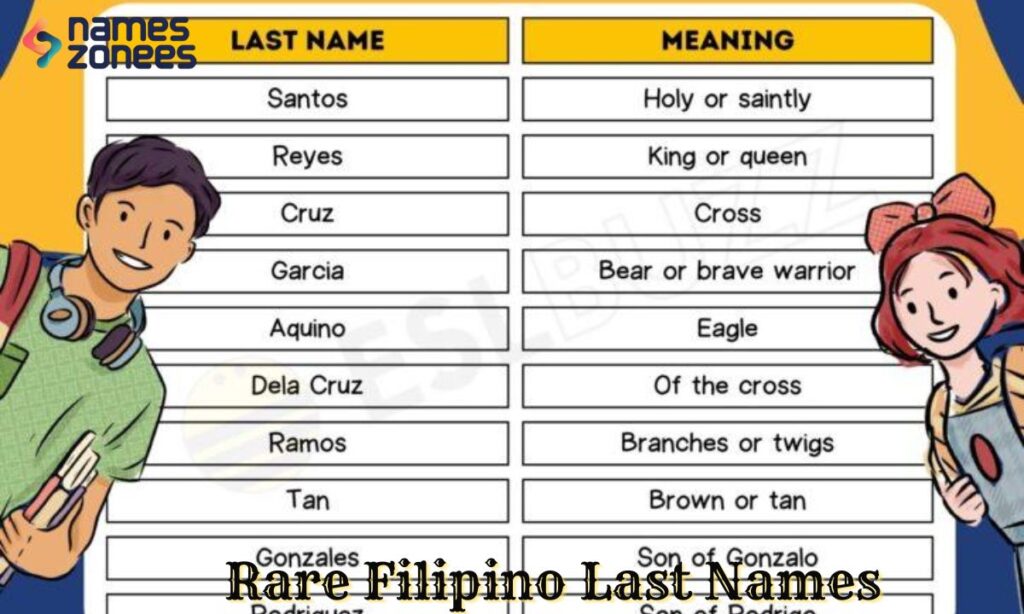
Rare Filipino Last Names can preserve regional history that is less visible in national surname rankings.
Some appear in historical surname catalogs but remain uncommon in modern records.
For unusual names, researchers should avoid assuming that rarity means a particular ethnic origin.
| Name | Meaning |
| Abacan | • A documented surname in the 1849 surname catalog; precise etymology is uncertain |
| Abalahin | • A documented Philippine surname; exact lexical meaning is uncertain |
| Abayari | • A cataloged Philippine surname; specific etymology is uncertain |
| Abinsay | • A historical Philippine surname with no securely established common English meaning |
| Abiog | • A documented surname in the historical catalog; exact meaning is uncertain |
| Ablang | • A Philippine surname recorded in the historical surname lists; precise meaning is uncertain |
| Abucajo | • A catalog surname; its exact lexical origin is not securely established |
| Abueg | • A documented Philippine surname; family-specific etymology may vary |
| Acda | • A historical Philippine surname; precise lexical meaning is uncertain |
| Aclan | • A Philippine surname associated with Aklan and regional naming traditions |
| Acupan | • A documented surname in the 1849 catalog; exact meaning is uncertain |
| Adlawan | • A Philippine surname with regional usage; precise etymology is uncertain |
| Afuyog | • A historical Philippine surname; exact lexical meaning is uncertain |
| Agamata | • A cataloged Philippine surname; its specific etymology is uncertain |
| Aganad | • A documented Philippine surname; exact meaning is not securely established |
| Agatep | • A historical surname associated with Philippine naming records; etymology is uncertain |
| Agawin | • A Philippine surname recorded historically; precise surname meaning is uncertain |
| Agbisit | • A documented indigenous Philippine surname; exact lexical meaning is uncertain |
| Agbulos | • A historical Philippine surname; detailed etymology is uncertain |
| Agcamaran | • A surname recorded in the historical catalog; exact meaning is uncertain |
| Agcambot | • A cataloged Philippine surname; precise lexical origin is uncertain |
| Agdeppa | • An indigenous Ilocano surname; exact lexical meaning is uncertain |
| Agdinaoay | • An Ilocano surname recorded in historical lists; exact meaning is uncertain |
| Aggabao | • A documented Philippine surname; precise etymology is uncertain |
| Agngarayngay | • A historical Philippine surname; exact lexical meaning is uncertain |
| Agonoy | • A Philippine surname recorded historically; exact meaning is uncertain |
| Agpalo | • A documented Philippine surname; precise etymology requires regional linguistic evidence |
| Agsalog | • A historical Philippine surname; exact lexical meaning is uncertain |
| Agtarap | • An Ilocano surname documented in regional surname lists |
| Agtutubo | • A historical Philippine surname; precise lexical meaning is uncertain |
Native Filipino Surnames
Native Filipino Last Names can come from Philippine languages rather than European naming traditions.
Ilocano surname records, for example, contain distinctive forms that developed within local communities.
For many indigenous surnames, a reliable dictionary meaning cannot be established without knowing the family’s linguistic and regional background.
| Name | Meaning |
| Agbayani | • Ilocano surname traditionally associated with a hero or brave person |
| Aglipay | • Indigenous Ilocano surname; exact lexical meaning is regionally interpreted |
| Agpaoa | • Ilocano surname; precise lexical meaning is not securely established |
| Bagaoisan | • Indigenous Ilocano surname; exact lexical meaning is uncertain |
| Bumanglag | • Ilocano surname recorded in northern Philippine naming traditions |
| Duldulao | • Indigenous Philippine surname; precise lexical meaning is uncertain |
| Dumlao | • Indigenous surname associated with Ilocano naming traditions |
| Ulep | • Indigenous Ilocano surname; exact lexical meaning is uncertain |
| Vinoya | • Ilocano surname documented in northern Philippine communities |
| Manalo | • Tagalog surname commonly connected with the idea of winning or prevailing |
| Ragasa | • Philippine surname associated with local-language naming traditions |
| Nalundasan | • Indigenous Philippine surname documented in northern Philippine records |
| Domongan | • Indigenous surname associated with Cordilleran naming traditions |
| Baguilat | • Indigenous Philippine surname associated with Cordilleran communities |
| Macliing | • Indigenous Cordilleran surname; precise lexical meaning depends on local language |
| Dulag | • Indigenous Philippine surname documented in Cordilleran history |
| Panganiban | • Tagalog surname; traditionally associated with danger or a dangerous place |
| Malvar | • Philippine surname with regional usage; exact surname etymology is uncertain |
| Nakpil | • Tagalog surname; commonly associated with a traditional personal-name origin |
| Jacinto | • A surname derived from the hyacinth flower name |
| Silang | • A Philippine surname associated with local historical naming; exact lexical origin varies |
| Sakay | • A Tagalog surname associated with a local word meaning to ride or board |
| Bukaneg | • Indigenous northern Philippine surname associated with early Ilocano literary history |
| Sumulong | • Tagalog surname associated with moving forward or advancing |
| Valenzuela | • A Philippine surname of Spanish place-name origin, retained in local family history |
| Arellano | • Spanish-origin surname established in Philippine families; associated with a place lineage |
| Caluya | • Philippine surname with regional usage; exact etymology is uncertain |
| Ponce | • Spanish surname from a personal name, historically used by Filipino families |
| Cailles | • Philippine surname associated with a historical family; exact deeper etymology is uncertain |
| Pichay | • Philippine surname associated with regional usage; exact etymology is uncertain |
Spanish Filipino Surnames
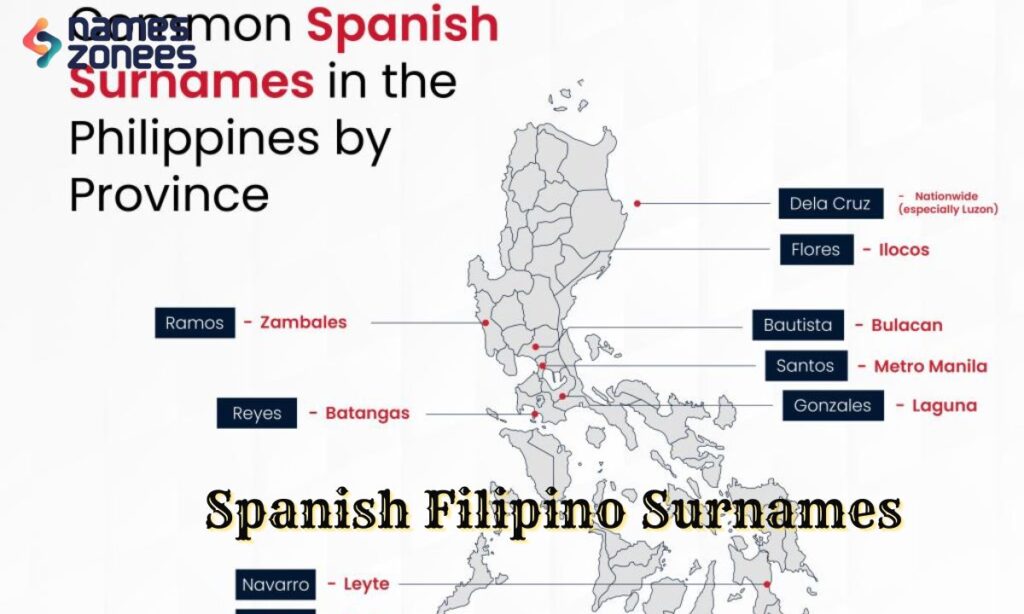
Spanish Filipino Last Names became widespread during the Spanish colonial period and especially after nineteenth-century surname standardization.
Many are genuine Spanish surnames, while others were simply assigned or selected from approved lists.
Therefore, carrying a Spanish surname does not by itself prove Spanish ancestry.
| Name | Meaning |
| Acosta | • Spanish and Portuguese surname associated with someone living near a coast or slope |
| Ballesteros | • Associated with crossbowmen or makers of crossbows |
| Bautista | • “Baptist,” connected with John the Baptist |
| Madriaga | • A Spanish surname associated with a place or family lineage |
| Manzano | • “Apple tree” in Spanish |
| Molina | • “Mill” or mill-related place surname |
| Pasion | • “Passion,” especially in Christian vocabulary |
| Peralta | • Spanish place surname, traditionally connected with “high rock” |
| Ramirez | • “Son of Ramiro” |
| Tamayo | • A Spanish surname of old Iberian origin; precise original meaning is uncertain |
| Valdez | • “Son of Valdo” or a related patronymic form |
| Acuna | • Spanish and Portuguese place/family surname associated with Acuña |
| Aguirre | • Basque surname traditionally interpreted as exposed or prominent place |
| Alarcon | • Spanish place surname associated with Alarcón |
| Alfaro | • Spanish place surname, associated with Alfaro |
| Benavidez | • “Son of Benavides,” a Spanish family name |
| Bonilla | • Spanish surname associated with a place or family lineage |
| Briones | • Spanish surname associated with Briones, a place in La Rioja |
| Cardenas | • Spanish surname associated with the place Cárdenas |
| Carrillo | • Spanish surname traditionally connected with a physical nickname meaning cheek |
| Cervantes | • Spanish surname associated with the Cervantes family/place tradition |
| Collado | • “Mountain pass” or hill pass |
| Contreras | • Spanish place surname associated with Contreras |
| Correa | • Spanish surname traditionally associated with a leather strap or belt |
| Duran | • Derived from a personal name meaning enduring or steadfast |
| Escobar | • Spanish surname associated with a place or broom-covered landscape |
| Fuentes | • “Fountains” or springs |
| Lozano | • “Lively,” “vigorous,” or spirited |
| Miranda | • “Admirable” or a place surname associated with Miranda |
| Navarro | • “Navarrese,” referring to someone from Navarre |
Read More: https://nameszonees.com/female-viking-names/
Filipino Last Names With Meanings
The meanings behind Filipino Last Names often reveal whether a surname began as a patronymic, place name, occupational term, nickname, or religious expression.
Some meanings are straightforward translations, while others depend on older Spanish, Basque, Italian, Arabic, or Philippine languages.
For that reason, surname meanings should be treated as etymological clues rather than proof of family history.
| Name | Meaning |
| Abad | • “Abbot” in Spanish |
| Abella | • A Spanish surname associated with the personal/family name Abella |
| Acevedo | • Spanish surname associated with a holly-grove place name |
| Adona | • Philippine surname with Spanish-language form; deeper family etymology varies |
| Almeda | • Spanish and Portuguese place/family surname |
| Amador | • “Lover” or one who loves |
| Aquino | • Place surname from Aquino in Italy |
| Barrios | • “Neighborhoods” or districts |
| Beltran | • From a Germanic personal name traditionally interpreted as bright raven |
| Bernardo | • Derived from Bernard, traditionally meaning brave bear |
| Blanco | • “White” |
| Bravo | • “Brave,” “bold,” or spirited |
| Bueno | • “Good” |
| Caballero | • “Horseman” or gentleman |
| Campo | • “Field” or countryside |
| Carmona | • Spanish place surname associated with Carmona |
| Clemente | • “Merciful” or gentle |
| Corazon | • “Heart” in Spanish |
| Delgado | • “Thin” or slender |
| Encarnacion | • “Incarnation,” a Christian religious term |
| Enriquez | • “Son of Enrique” |
| Espiritu | • “Spirit” in Spanish |
| Feliciano | • “Fortunate” or happy |
| Ferrer | • Occupational surname connected with an ironworker or blacksmith |
| Gallego | • “Galician,” referring to Galicia |
| Heredia | • Spanish surname associated with a place/family lineage |
| Iglesias | • “Churches” |
| Ledesma | • Spanish place surname associated with Ledesma |
| Luna | • “Moon” |
| Rosario | • “Rosary,” referring to the Catholic prayer tradition |
History of Filipino Surnames
The history of Filipino Last Names is closely connected to changing systems of administration and record keeping.
Before standardized hereditary surnames became widespread, naming practices differed considerably between communities.
The Spanish colonial government later introduced measures designed to make personal identification and taxation easier.
| Name | Meaning |
| Abalos | • Spanish surname associated with a family or place name |
| Acebedo | • Variant of Acevedo, associated with a holly-grove place name |
| Aguinaldo | • A Spanish surname; in Spanish, aguinaldo also refers to a Christmas gift |
| Alonzo | • Variant of Alonso, from a Germanic personal name traditionally linked with nobility |
| Andrade | • Portuguese and Galician surname associated with a place/family lineage |
| Araneta | • Spanish/Basque family surname associated with the Araneta lineage |
| Bautista | • “Baptist,” a Christian surname |
| Benitez | • “Son of Benito” |
| Buencamino | • “Good road” or “good path” in Spanish |
| Burgos | • Spanish place surname associated with Burgos |
| Cagayan | • Philippine geographic surname associated with the Cagayan region |
| Calo | • Philippine surname with regional usage; exact etymology varies |
| Capistrano | • Italian/Spanish surname associated with Capistrano |
| Carreon | • Spanish surname associated with regional family/place traditions |
| Coronel | • “Colonel” in Spanish; an occupational or title-based surname |
| Del Pilar | • “Of the pillar,” a Christian Marian reference |
| De Vera | • “Of Vera,” a Spanish family/place surname |
| Esguerra | • Spanish surname associated with the Esguerra family lineage |
| Evangelista | • “Evangelist” |
| Famy | • A Philippine family surname with a documented historical lineage; precise deeper meaning is uncertain |
| Felipe | • Surname derived from Philip, traditionally meaning “lover of horses” |
| Gomez | • “Son of Gome,” from a medieval personal name |
| Jacinto | • Derived from the hyacinth flower name |
| Legaspi | • Basque-origin family surname associated with Legazpi |
| Llorente | • Spanish surname associated with the personal name Lorenzo |
| Mabini | • Philippine surname associated with the Tagalog word mabini, traditionally “modest” or restrained |
| Mercado | • “Market” |
| Rizal | • Philippine family surname famously used by José Rizal; commonly associated with a Spanish term for a field where rice is grown |
| Roxas | • Spanish surname associated with the Rojas family/place tradition |
Where Filipino Last Names Come From
Filipino Last Names can have several different sources, including indigenous languages, Spanish family names, Christian vocabulary, geographic names, and Chinese or other immigrant traditions.
The same surname may also have different histories in different Filipino families.
A genealogical record is therefore more reliable than surname appearance alone when tracing ancestry.
| Name | Meaning |
| Chua | • Chinese surname form used by Filipino Chinese families; exact meaning depends on the Chinese character |
| Co | • Chinese surname form commonly found among Filipino Chinese families |
| Dy | • Chinese surname form used in Philippine Chinese communities |
| Gokongwei | • Chinese Filipino family surname; exact meaning depends on its original Chinese characters |
| Lim | • Chinese surname form commonly used by Filipino Chinese families |
| Ong | • Chinese surname form associated with Chinese Filipino communities |
| Sy | • Chinese surname form widely used in the Philippines |
| Tan | • Hokkien Chinese surname form associated with 陳/陈 |
| Tiu | • Chinese surname form used by Filipino Chinese families |
| Yap | • Chinese surname form used in Philippine Chinese communities |
| Yao | • Chinese surname form associated with the Yao family tradition |
| Ang | • Chinese surname form used by Filipino Chinese families |
| Go | • Chinese surname form found in the Philippines |
| Koa | • Chinese Filipino surname form; exact etymology depends on original Chinese characters |
| Kho | • Chinese surname form used in Philippine Chinese communities |
| Koa | • A Chinese Filipino surname form; family etymology depends on the source dialect and character |
| Lao | • Chinese surname form used by Filipino Chinese families |
| Lee | • Chinese surname spelling used in Philippine Chinese communities |
| Que | • Chinese Filipino surname form; exact meaning depends on original Chinese character |
| Uy | • Chinese surname form used in Filipino Chinese communities |
| Chiong | • Chinese Filipino surname form associated with Chinese-language family naming |
| Ching | • Chinese surname form used by Filipino Chinese families |
| Keng | • Chinese Filipino surname form; exact meaning depends on original Chinese character |
| Koo | • Chinese surname form used in Philippine Chinese communities |
| Limjoco | • Chinese Filipino compound family surname; exact meaning requires the original Chinese form |
| Ongpin | • Chinese Filipino surname associated with a historic Chinese Filipino family |
| Pua | • Chinese surname form used in the Philippines |
| Sia | • Chinese surname form used by Filipino Chinese families |
| Tanchanco | • Chinese Filipino family surname; precise meaning depends on the original Chinese characters |
| Yuchengco | • Chinese Filipino compound surname; exact meaning depends on its Chinese source |
The Catálogo alfabético de Apellidos
The Catálogo alfabético de apellidos was published in 1849 following Governor-General Narciso Clavería’s surname decree.
It provided an extensive selection of surnames for people who needed standardized family names.
The catalog explains why many Filipino families share surnames of Spanish appearance without having direct Spanish ancestry.
| Name | Meaning |
| Abadiano | • Spanish-derived catalog surname; associated with Abad-type family naming |
| Abella | • Spanish family surname associated with the Abella lineage |
| Abarca | • Spanish surname historically associated with a type of footwear or family/place tradition |
| Abrego | • Spanish surname associated with the southwest wind, ábrego |
| Aceituno | • “Olive tree” or olive-related surname |
| Adalid | • “Leader” or guide |
| Aguila | • “Eagle” in Spanish |
| Alarcon | • Spanish place/family surname |
| Alcantara | • Spanish surname from Alcántara, ultimately of Arabic place-name origin |
| Alcazar | • “Fortress” or palace-fortification |
| Aldana | • Spanish surname associated with a place/family lineage |
| Alegre | • “Happy,” cheerful, or lively |
| Amaya | • Spanish surname associated with the place Amaya |
| Aparicio | • Spanish surname derived from a personal name associated with appearance or manifestation |
| Aragon | • “From Aragón,” the Spanish region |
| Arevalo | • Spanish place surname from Arévalo |
| Belmonte | • “Beautiful mountain” |
| Bermudez | • “Son of Bermudo” |
| Cabrera | • Spanish surname associated with goats or goat country |
| Canete | • Spanish place surname associated with Cañete |
| Cardona | • Spanish place/family surname from Cardona |
| Carranza | • Basque-origin Spanish surname associated with Carranza |
| Castañeda | • “Place of chestnut trees” |
| Ceballos | • Spanish surname associated with a historical family/place name |
| Cisneros | • Spanish surname associated with Cisneros, a place name |
| Cordova | • Spanish place surname from Córdoba |
| Cuenca | • Spanish place surname from Cuenca |
| Escudero | • “Squire” or shield bearer |
| Espinosa | • “Thorny” or associated with thorn-covered land |
| Estrada | • “Road” or roadway |
How to Find Your Surname in the Catálogo
Finding a surname in the Catálogo can be useful for family-history research, but it should not be treated as proof of ancestry.
Historical spellings may differ from modern spellings because surnames changed through transcription, regional pronunciation, and later record keeping.
An online transcription contains more than 2,300 cataloged surnames and can be searched alphabetically.
| Name | Meaning |
| Abad | • “Abbot” |
| Abalos | • Spanish family/place surname; exact deeper etymology varies |
| Acevedo | • Associated with a holly grove |
| Adame | • Spanish surname derived from Adam |
| Agreda | • Spanish place surname associated with Ágreda |
| Albacete | • Spanish place surname from Albacete |
| Alcocer | • Spanish surname associated with a place name |
| Aldana | • Spanish family/place surname |
| Almonte | • Spanish place surname associated with Almonte |
| Angulo | • “Angle” or corner; also a Spanish family surname |
| Aranda | • Spanish place/family surname associated with Aranda |
| Aro | • Spanish surname associated with a place/family tradition |
| Avila | • “From Ávila,” a Spanish place surname |
| Baeza | • Spanish place surname from Baeza |
| Balagtas | • Philippine surname associated with the historic Tagalog literary name Balagtas; deeper etymology is uncertain |
| Barredo | • Spanish surname associated with a family/place tradition |
| Belen | • “Bethlehem,” used as a Christian surname |
| Borja | • Spanish family/place surname associated with Borja |
| Calderon | • Cauldron-related occupational surname |
| Carvajal | • Spanish surname associated with oak-covered land |
| Casanova | • “New house” in Spanish |
| Chacon | • Spanish family/place surname |
| Coloma | • Spanish surname associated with a family/place tradition |
| Damaso | • Surname derived from the personal name Damaso |
| Escalante | • Spanish place/family surname |
| Figueroa | • Associated with fig trees or a fig-tree place |
| Fonseca | • Spanish and Portuguese place surname |
| Granados | • “Pomegranates” or pomegranate trees |
| Hurtado | • Spanish surname traditionally interpreted as “taken away” or “stolen” |
| Zamora | • Spanish place surname from Zamora |
Frequently Asked Questions
Are Filipino Last Names mostly Spanish?
Many Filipino Last Names have Spanish forms, largely because of Spanish colonial administration and the 1849 surname decree. However, the Philippines also has indigenous, Chinese Filipino, and other family names. A Spanish-looking surname does not automatically mean that the family has Spanish ancestry.
Why do so many Filipino families share the same surname?
The widespread use of standardized surnames increased after the 1849 decree associated with Governor-General Narciso Clavería. The catalog supplied names that could be distributed across communities, helping colonial officials maintain more consistent records and reduce confusion.
Does having a Spanish surname mean I have Spanish ancestry?
No. A surname can suggest a linguistic or historical connection, but it cannot establish biological ancestry by itself. Many Filipino families received or adopted surnames from the official surname catalog without having Spanish ancestors. Genealogical documents provide much stronger evidence.
What is the Catálogo alfabético de apellidos?
The Catálogo alfabético de apellidos is a nineteenth-century surname catalog published in Manila in 1849. It was associated with the surname decree of Governor-General Narciso Clavería and became an important part of the development of standardized family naming in the Philippines.
How can I research my Filipino family surname?
Start with civil registrations, baptismal records, marriage documents, census materials, cemetery records, and older family documents. Then compare historical spellings with the Catálogo alfabético de apellidos. A surname appearing in the catalog can provide a research lead, but it does not by itself establish a family relationship.
Conclusion
Filipino family names tell a story that reaches far beyond simple labels. They preserve traces of local languages, Spanish colonial administration, Christianity, migration, trade, and changing ideas about family identity. Looking closely at Filipino Last Names can therefore provide a fascinating starting point for understanding Philippine history and genealogy.
The most reliable approach is to treat a surname as a clue rather than a final answer. Whether a family carries a distinctive indigenous name, a widely shared Spanish surname, or a Chinese Filipino family name, its real history is best discovered through records passed down across generations. The combination of surname research and documented genealogy can make that search much more meaningful.

Jack Smith explores ideas, shares knowledge, and creates content that inspires curiosity and everyday learning.